
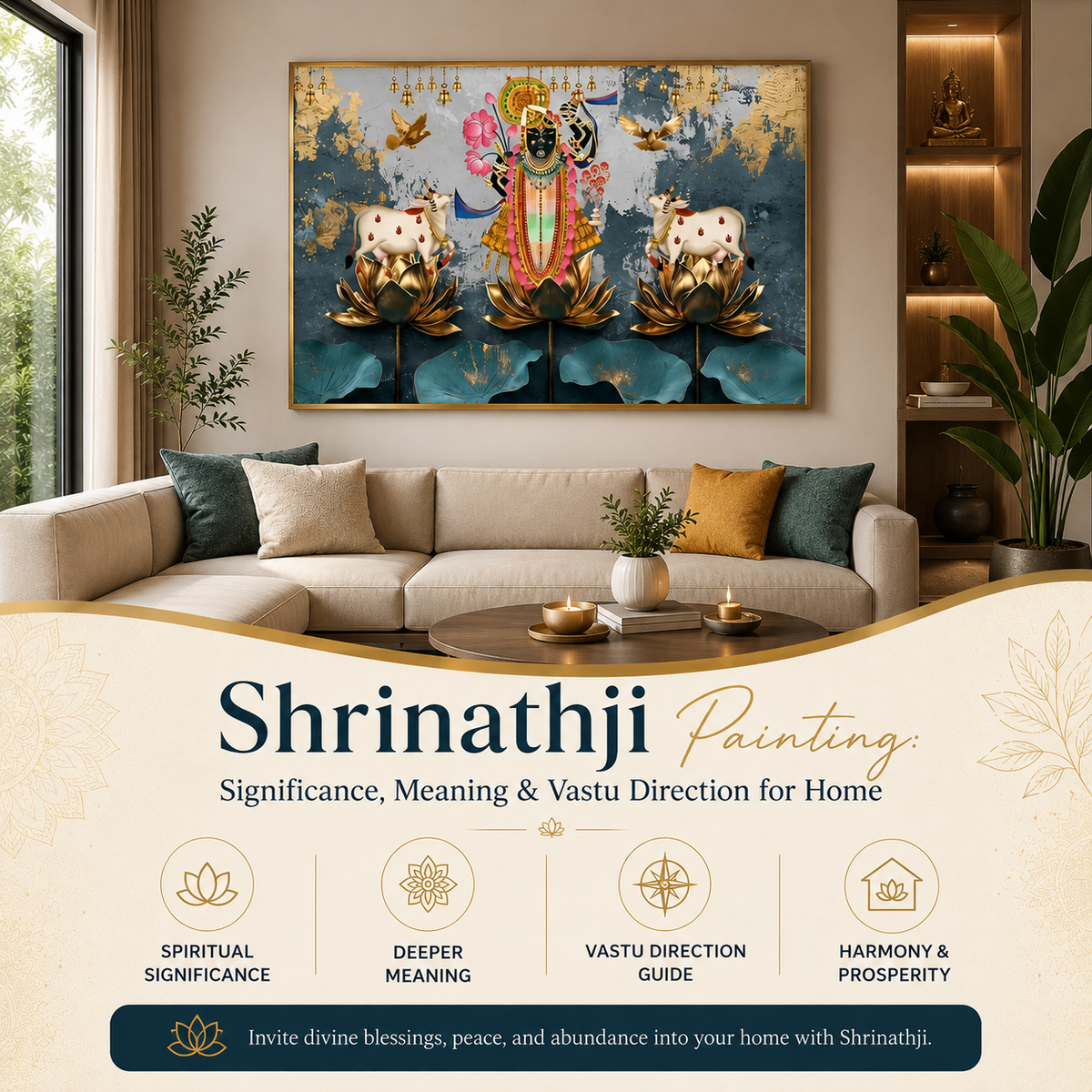
A Shrinathji painting is one of the most widely kept devotional artworks in Indian homes - a depiction of Lord Krishna as the child-god who lifted Govardhan Hill to shelter Vrindavan from Indra's storm. Rendered in the centuries-old Pichwai style of Nathdwara, Rajasthan, these paintings are believed to bring protection, prosperity, and devotion into a home, provided they're placed correctly as per Vastu Shastra.
Here's the complete guide: what the painting represents, which direction to hang it in, where to avoid, and how to choose between the different Pichwai styles available today.
Who Is Shrinathji?
Shrinathji is a form of Lord Krishna worshipped as a seven-year-old child, captured in the moment he lifted Govardhan Hill on his little finger to protect the people of Vrindavan from Lord Indra's wrath. He is the central deity of Pushtimarg Vaishnavism, and his primary shrine sits in Nathdwara, Rajasthan - one of the most visited pilgrimage towns in North India.
The Pichwai painting tradition began over 400 years ago as cloth backdrops hung behind the Shrinathji idol at the Nathdwara temple, depicting his daily leelas (divine pastimes) through the changing seasons and festivals. That temple lineage is why a Shrinathji painting carries more weight than typical religious decor - every element in the composition, from the cows to the lotus blooms to the peacock feathers, has a specific symbolic root in Krishna's life in Vrindavan.
What Does a Shrinathji Painting Symbolize?
- Protection and strength - the Govardhan-lifting pose represents shelter from hardship and divine intervention in times of crisis.
- Prosperity and abundance - Shrinathji is closely associated with wealth and provision, which is why he's frequently depicted alongside Kamdhenu, the wish-fulfilling cow.
- Devotion (bhakti) - as the central figure of Pushtimarg worship, the painting is a visual anchor for the practice of loving surrender to the divine, making it a natural fit for pooja rooms and meditation spaces.
- Peace and emotional calm - the serene expression, paired with the detailed lotus-and-cow backdrop typical of Pichwai art, is designed to hold the eye and mind in quiet focus.
Which Direction to Place a Shrinathji Painting (Vastu Guide)
Hang the painting on the North-East (Ishan) or East wall of your home, positioned so the image faces West or South - this lets you face East or North while praying, the orientation Vastu considers most receptive to divine energy. For prosperity and career-focused placements specifically, the North wall is also considered auspicious.
Most placement advice stops at "put it in the North-East." But there are two separate things to get right - the wall the painting is mounted on, and the direction the deity's gaze faces - and the second is the detail most people miss:
- Wall placement: North-East (Ishan corner) or East wall of the living room, hallway, or pooja room.
- Facing direction: Position the painting so Shrinathji faces West or South, so that you, standing in front of it, face East or North.
- Height: Hang at eye level or slightly above - never on the floor or low enough to be brushed against.
- Cleanliness: Keep the surrounding wall and floor space uncluttered, dusted, and well-lit.
- Avoid shared bathroom walls. Even a technically correct North-East wall should be skipped if it backs onto a toilet or bathroom.
- Avoid the bedroom, especially facing the bed - traditionally considered disrespectful to the deity and disruptive to rest.
- Don't place two deity images facing each other - arrange multiple devotional pieces side by side instead.
श्रीनाथजी की फोटो किस दिशा में लगाएं?
वास्तु शास्त्र के अनुसार, श्रीनाथजी की तस्वीर घर की उत्तर-पूर्व (ईशान कोण) या पूर्व दिशा की दीवार पर लगानी चाहिए, ताकि पूजा करते समय आपका मुख पूर्व या उत्तर दिशा की ओर रहे। स्नानघर या शयनकक्ष से सटी दीवार पर फोटो न लगाएं।
Where Not to Place It
- South-West wall - associated with grounding and material attachment rather than devotion.
- Bedroom, facing the bed - considered inappropriate for a deity image.
- Bathroom-adjacent walls or cluttered corners - undermines the placement regardless of compass accuracy.
- On the floor or below eye level - treated as disrespectful in most Vastu and devotional traditions.
Types of Shrinathji Paintings and Which One to Choose
- Shrinathji with cows and devotees - the classic Pichwai composition, best suited to pooja rooms or as a hallway centerpiece.
- Shrinathji with lotus and gold detailing - more ornamental, works well as an entrance-wall statement piece.
- Modern Shrinathji painting - a pared-back, contemporary read on the same iconography, suited to living rooms in minimalist interiors that still want a devotional anchor.
- Shrinathji with Kamdhenu cow - pairs Krishna's protector form with Kamdhenu, the celestial wish-fulfilling cow, doubling down on the prosperity symbolism. A popular choice for pooja rooms and home offices alike.
Shrinathji and Kamdhenu Cow Painting: Why They're Often Paired
Kamdhenu - also called Surabhi - is the celestial cow believed to have emerged from the churning of the cosmic ocean, revered as the mother of all cows and a source of unlimited abundance. Because Shrinathji's own iconography is inseparable from cows (a nod to his pastoral life in Vrindavan), Pichwai artists frequently combine the two: Shrinathji as protector, Kamdhenu as provider.
Vastu treats this combination the same way as a standalone Shrinathji painting - North-East or East wall, avoiding bathrooms and bedrooms - with the North wall specifically favoured when the intent is inviting wealth (the North is associated with Kubera, the Vastu deity of riches).
Frequently Asked Questions
What is the significance of a Shrinathji painting?
It represents Lord Krishna as Govardhan-dhari - the protector who lifted Govardhan Hill - and is believed to bring protection, prosperity, and devotion into a home.
Which direction is best for a Shrinathji painting as per Vastu?
North-East (Ishan corner) or East wall, positioned so the image faces West or South.
Can I keep a Shrinathji painting or idol at home?
Yes. Home worship of Shrinathji is standard practice within Pushtimarg Vaishnavism and isn't restricted to temples.
Can a Shrinathji painting be placed in the bedroom?
It's generally avoided, particularly facing the bed. A living room, hallway, or dedicated pooja space is preferred.
Is a Shrinathji and Kamdhenu combination painting good for a home office?
Yes - many people place this combination in a home office's North-East or North corner specifically for the prosperity association.
Shop our best-selling Shrinath Ji Vastu Wall Art, or explore the full Vastu & Divinity Paintings collection for more Vastu-compliant, Nathdwara-style pieces.
Related reading: Pichwai Cow Art: Kamdhenu's Blessings for Prosperity & Peace →