
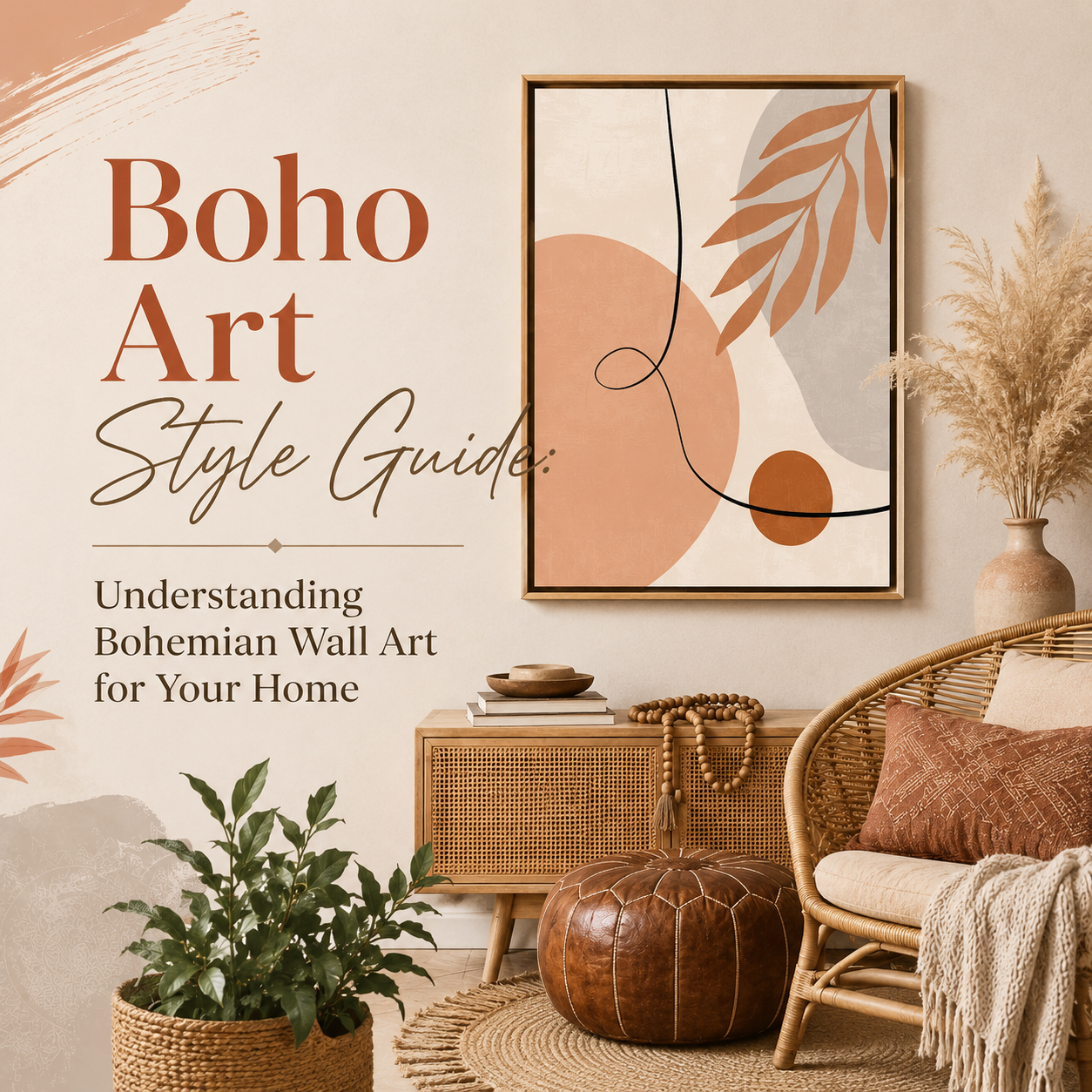
Walk into a home that's done boho right and you'll feel it before you can explain it. Nothing matches in the way a showroom matches. The colours are warm without being loud. There's a plant somewhere it probably shouldn't be. The art on the wall looks like it was collected over years rather than bought in a single trip - even when it wasn't.
That's the thing about boho art. It's one of the few interior styles that's genuinely about restraint dressed up as freedom. People assume bohemian means chaotic, maximalist, anything-goes. In practice, the boho wall art that actually works in a home follows a fairly specific visual language - and once you understand that language, choosing the right pieces gets a lot easier.
This guide covers what boho art actually is, where it comes from, what makes a piece read as boho rather than just abstract or minimal, and how to choose the right pieces for your own space.
What Is Boho Art?
Boho art - short for bohemian art - refers to a visual style built around organic shapes, earthy and muted colour palettes, natural motifs, and a deliberately relaxed, unforced composition. It draws loosely from the bohemian lifestyle movement of the 19th and 20th centuries, which itself borrowed visual cues from folk art, travel, craft traditions, and a general resistance to formal, rule-bound aesthetics.
In contemporary wall art, boho has evolved into something more specific and more wearable as a home decor style. It's less about literal bohemian symbolism - fewer dreamcatchers and macrame, less overt "hippie" imagery - and more about a consistent visual sensibility: soft sun motifs, abstract botanical shapes, sand and clay tones, minimal line work, and compositions that feel handmade even when they're printed.
If you're trying to identify boho art on sight, look for these recurring elements:
- Earthy, muted colour palettes - terracotta, sand, sage, rust, dusty pink, cream, charcoal. Rarely anything neon or high-saturation.
- Organic and abstract shapes - curved lines, arches, soft geometric forms that feel drawn rather than engineered.
- Natural motifs - suns, mountains, desert landscapes, leaves, botanical line drawings, cacti.
- Minimal line art - single-line figure drawings, simplified faces, gestural sketches.
- Asymmetry and imperfection - compositions that feel intuitive rather than rigidly balanced.
Where Boho Art Comes From

The word "bohemian" originally described a 19th-century European subculture of artists, writers, and free-thinkers living outside conventional social structures - the term itself borrowed (somewhat inaccurately) from the Roma people, who Parisians at the time associated with Bohemia in central Europe.
That history matters less for decor purposes than what came after. The aesthetic resurfaced strongly in the 1960s and '70s counterculture movement, picked up handcrafted textures, ethnic prints, and natural materials, and then went quiet for a few decades before returning - reinterpreted - as one of the dominant home decor styles of the 2010s and 2020s.
What changed in that reinterpretation is important: modern boho art shed a lot of the clutter and embraced minimalism instead. Today's bohemian wall art is closer to Scandinavian design in its restraint than to its 1970s ancestor. The earthy colour sensibility stayed. The visual noise mostly didn't.
Boho Art vs Abstract Art: What's the Difference?

This comes up often because the two styles overlap visually, and the line between them isn't always obvious at first glance.
Abstract art, as a category, can use any colour palette and any degree of structure - bold primary colours, sharp geometry, high contrast. Boho art is really a specific subset within that broader space, defined by its restricted, earthy palette and its preference for organic over geometric forms.
A piece with sharp black and white geometric shapes is abstract but not boho. A piece with the same compositional looseness rendered in terracotta and sand tones, with a soft sun or leaf motif worked in, reads immediately as boho. The shapes can be similar. The palette and subject matter are what carry the style.
If you want to compare the two side by side, the broader abstract wall art collection sits alongside the boho wall art collection - worth browsing together if you're still deciding which direction suits your space.
Why Boho Art Has Stayed Popular
A few practical reasons explain why bohemian wall art hasn't faded the way a lot of decor trends do.
It's genuinely versatile. The muted, earthy palette doesn't fight with most existing interior colour schemes, which means it works in homes that haven't fully committed to one design direction yet - a common situation for anyone renting, recently moved, or still furnishing room by room.
It photographs well without trying hard. The soft tones and gentle compositions read as calm and put-together even in less-than-perfect lighting, which matters more than people admit in an era where most of us see our own homes through a phone camera as often as in person.
And it pairs naturally with the broader shift toward warmer, more textured interiors - wood furniture, woven baskets, linen, ceramics. Boho art isn't competing with that material language; it's part of it.
Boho Art Styles Worth Knowing
Within the broader boho category, a few distinct sub-styles show up consistently enough to be worth naming individually.
Desert and Sun Motifs
Cactus silhouettes, desert dunes, and minimal sun illustrations are probably the most recognisable boho subgenre. The Cactus Desert Canvas Wall Art and Desert Boho Canvas Wall Art with sun and leaf stem are good examples - warm, sparse compositions that bring a quiet, sun-baked stillness to a room.
Botanical Line Art
Simplified leaf shapes and plant forms, often rendered as minimal outlines rather than detailed botanical illustrations. The Pastel Green Leaf Canvas Wall Art and Earthy Leaf Stem Boho Wall Art fall into this category - they bring a botanical presence into a room without needing an actual plant nearby.
Abstract Geometric Boho
Soft, rounded geometric shapes - arches, semi-circles, layered forms - stacked or arranged in loose compositions. The Stacked Semi-Circle Boho Canvas Wall Art and Boho Geometric Canvas Wall Art with minimal lines and circles are strong examples of this - structured enough to feel intentional, loose enough to stay warm.
Landscape and Mountain Scenes
Stylised, painterly landscapes in muted tones - mountains, horizons, layered colour fields suggesting distance. The Colorful Mountain View Canvas Wall Art and Calm Horizon Canvas Wall Art bring a sense of openness to a room, which works particularly well in smaller spaces where an actual view isn't available.
Minimal Figure and Portrait Line Art
Single-line or simplified figure drawings - a side profile, a seated form, a face reduced to a few essential lines. The Boho Single Line Face Canvas Wall Art and the Japanese Boho Girl Canvas Wall Art sit here - a more personal, human element within the broader earthy palette.
Earth-Toned Object Studies
Still-life style compositions - stacked bowls, ceramic vases, pebbles, everyday objects rendered simply. The Stacked Earth Bowls Canvas Wall Art and Stacked Pebbles Boho Canvas Wall Art belong to this quieter, more meditative corner of the style.
How to Choose Boho Art for Your Home
Understanding the style is one thing. Choosing pieces that actually work in your specific space is a separate decision, and a few practical questions help narrow it down.
What room is it going in?
Boho art tends to suit living rooms and bedrooms best, where its calming palette has room to breathe. In a living room, it pairs naturally with the kind of layered, textured seating area boho interiors are known for - a sofa with throws, a low coffee table, an indoor plant nearby. In a bedroom, the muted tones make it one of the more restful wall art choices available, particularly above a headboard or on the wall facing the bed.
It works less naturally in highly formal spaces - a traditional dining room, a very corporate home office - where its informality can feel slightly out of place against more structured furniture.
What's your existing colour palette?
This is the single most important factor. Boho art's earthy tones - terracotta, sand, sage, rust - sit comfortably with neutral interiors (white, beige, grey walls) and with warm wood furniture. If your room already leans cool - heavy blues, stark whites, chrome and glass - a boho piece can still work, but choose one with a slightly more muted or desaturated palette so it doesn't feel like it wandered in from a different house.
Single canvas or a set?

Boho compositions, because of their soft visual weight, often work better in pairs or sets of three than as a single piece, particularly on longer walls. A trio of related boho canvases - say, a sun motif, a botanical line drawing, and an abstract geometric piece, all in the same tonal family - creates more depth than one piece alone, without ever feeling busy.
What size suits the wall?

Because boho compositions tend to have a lot of negative space, smaller pieces can sometimes look underwhelming on a large wall - the emptiness within the composition compounds the emptiness of the wall around it. For larger walls, sizing up to 24×36 inches or choosing a set of two or three smaller canvases together usually reads better than one undersized single piece.
Frame or canvas wrapped?

Canvas wrapped suits boho's relaxed, unfussy character particularly well - no visible frame, no formal edge, just the composition extending naturally to the canvas border. A black floater frame works too, and adds a touch more definition if the surrounding decor is slightly more polished. Gold frames tend to clash with boho's deliberately understated tone and are generally better suited to more traditional or maximalist styles.
Styling Boho Art in a Room

A few things make boho wall art feel intentional rather than incidental once it's actually on the wall.
Pair it with texture, not just colour. Boho art reads best in rooms that already have some tactile variety - a woven basket, a linen throw, a wooden console, a ceramic vase. The art becomes part of a broader sensory language rather than a flat decoration.
Let the wall breathe. Boho interiors generally avoid the densely packed, maximalist gallery wall approach in favour of more deliberate spacing - one or two pieces with room around them, rather than a wall completely filled.
Keep greenery nearby. Indoor plants and boho wall art have become so visually linked that the pairing almost reads as a single design decision rather than two separate ones. A plant near a boho canvas reinforces the organic, natural language of the artwork itself.
Frequently Asked Questions About Boho Art
Is boho art the same as bohemian art?
Yes - "boho" is simply the shortened, more commonly used form of "bohemian." Both refer to the same visual style: earthy palettes, organic shapes, natural motifs, and relaxed compositions.
What colours are typically used in boho wall art?
Terracotta, sand, rust, sage green, dusty pink, cream, and charcoal are the colours most consistently associated with boho art. The palette stays muted and warm rather than bright or high-contrast, which is part of what gives the style its calm, settled feeling.
Does boho art suit modern or minimalist homes?
It does, and arguably suits them better than more traditional homes. Contemporary boho art has moved closer to minimalism over the past decade, with cleaner lines and more restrained compositions than its 1970s predecessor. It pairs comfortably with Scandinavian and modern minimalist interiors precisely because of this shared restraint.
Can boho art and abstract art be mixed on the same wall?
Yes, as long as the colour palette stays consistent. A boho piece and a non-boho abstract piece can sit together on a gallery wall if both lean into similar muted, earthy tones. What breaks the cohesion is mixing a soft boho palette with a high-contrast or brightly saturated abstract piece - the two will compete rather than complement each other.
What's the difference between boho and Scandinavian wall art?
Scandinavian style tends toward cooler, more neutral palettes - whites, greys, black line work - and stricter geometric minimalism. Boho leans warmer, with earthy tones and more organic, hand-drawn-feeling shapes. The two overlap in their shared minimalism but diverge clearly in colour temperature and subject matter.
Explore Other Collections from Cipher Spaces
If boho art feels like the right direction for your home, these collections are worth browsing alongside it:
- Abstract Wall Art - For a broader range of palettes and compositions beyond boho's earthy restraint.
- Floral Wall Art - More detailed botanical pieces, for those who want plant motifs with greater realism than boho's minimal line work.
- Scenery Wall Art - Landscape and nature pieces with more depth and detail than boho's stylised, flattened compositions.
- Modern Wall Art - Contemporary subjects and treatments for homes that want a more current aesthetic without boho's specific earthy palette.
- Bedroom Wall Art - Curated specifically for bedroom walls, where boho's calming tones tend to work particularly well.