
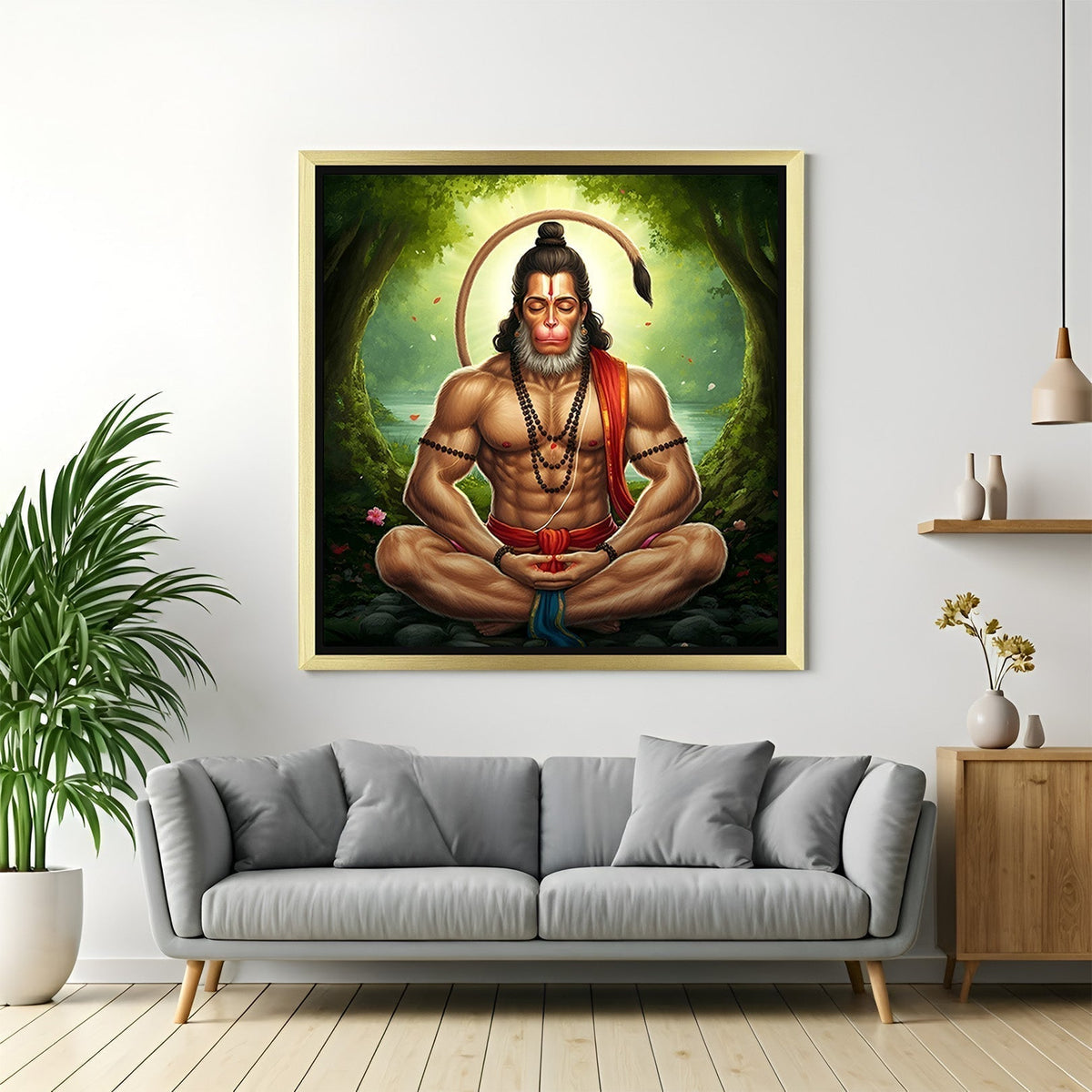
Lord Hanuman is widely associated with strength, courage, devotion and selfless service in Hindu tradition. This makes Hanuman paintings a meaningful choice for pooja rooms, living spaces, entrances, studies and home offices.
But which Hanuman photo is good for home? There is no single form that suits every space. Panchmukhi Hanuman is commonly chosen for protection-oriented symbolism, seated or meditative Hanuman for devotion and focus, Hanuman with Shri Ram for bhakti, and Flying Hanuman carrying the Sanjeevani mountain for courage, determination and service.
The best choice depends on the form of Hanuman, the room and where the artwork will be placed.
Which Hanuman Photo Is Good for Home?
Choose the Hanuman form according to the meaning and atmosphere you want the artwork to bring into the space.
| Hanuman Form | Traditional Association | Suitable Setting |
|---|---|---|
| Panchmukhi Hanuman | Protection, courage and vigilance | Entrance, living area or sacred space |
| Seated or Meditative Hanuman | Devotion, discipline and concentration | Pooja room, meditation corner or study |
| Hanuman with Shri Ram | Bhakti, loyalty and surrender | Pooja room or peaceful living area |
| Flying Hanuman with Sanjeevani | Courage, determination and selfless service | Living room, study, gym or workspace |
| Peaceful or Blessing Hanuman | Faith and devotional presence | Pooja room or general sacred space |
For a general home setting, a peaceful or devotional depiction is often the easiest choice. Panchmukhi and Flying Hanuman work particularly well when you want the artwork to carry stronger protective or motivational symbolism.
Can a Hanuman Picture Be Kept at Home?
Yes. Hanuman pictures, paintings and idols are commonly kept in Hindu homes as symbols of devotion, courage and strength.
For respectful placement:
- Choose a clean and intentional location.
- Avoid placing sacred artwork immediately beside bathrooms, footwear or cluttered storage.
- Pooja rooms, living spaces, studies and meditation areas are generally suitable locations.
- Choose the form according to the room rather than treating every Hanuman image identically.
Religious significance and Vastu recommendations should also be distinguished: Hanuman's devotional importance comes from Hindu tradition, while specific wall and direction rules generally come from Vastu practices and can vary.
Where Should a Hanuman Photo Be Placed at Home?
Placement depends on both the Hanuman form and the purpose of the room. South-oriented placement is frequently discussed in Vastu guidance for Hanuman, particularly for protection-associated forms, while devotional forms are often placed within the household's existing pooja-room orientation.
| Hanuman Form | Commonly Chosen Location | Direction / Placement Guidance |
|---|---|---|
| Panchmukhi Hanuman | Entrance, living area, pooja space | South-oriented placement is commonly discussed in Vastu practice |
| Seated / Meditative Hanuman | Pooja room, meditation area, study | Follow the orientation of the home shrine or sacred space |
| Hanuman with Shri Ram | Pooja room, devotional living area | Best treated primarily as devotional artwork rather than direction-led décor |
| Flying Hanuman | Living room, study, office, gym | No single form-specific direction is universally followed; prioritize an appropriate, prominent wall |
| Peaceful / Blessing Hanuman | Pooja room or living area | Place respectfully according to the room's devotional setup |
Which Wall Should Hanuman Photo Be Placed On?
In Vastu-oriented guidance, south-oriented placement is one of the most frequently mentioned choices for Hanuman imagery, particularly Panchmukhi and protection-associated forms.
However, the exact recommendation can depend on whether someone is referring to:
- the direction of the wall,
- the location of the artwork within the house,
- or the direction Hanuman is shown facing.
These are different concepts and should not be treated as interchangeable.
Which Direction Should Hanuman Ji Face?
The wall direction and Hanuman's facing direction are not the same thing.
If a painting is installed on a south-side wall, that describes where the artwork is located. It does not automatically tell you which direction Hanuman is visually facing in the image.
South-facing Hanuman is commonly discussed in Vastu traditions, but households and practitioners differ in how they interpret the relationship between the deity's facing direction and the wall on which the image is installed.
If you are following strict Vastu rather than choosing the artwork primarily for devotion or décor, confirm the precise orientation before fixing the painting permanently.
Panchmukhi Hanuman Photo: Meaning, Direction & Placement
Panchmukhi Hanuman depicts Hanuman in his five-faced form and is traditionally associated with vigilance, courage and protection.
This makes it one of the most commonly chosen Hanuman forms for people specifically searching for protective symbolism in the home.
Can Panchmukhi Hanuman Be Kept at Home?
Yes. Panchmukhi Hanuman imagery is kept in many homes, particularly in prayer areas, living spaces and entrance-related locations.
As sacred imagery, it is best displayed in a clean and respectful setting rather than treated as casual decoration.
Where to Place Panchmukhi Hanuman Photo at Home?
In Vastu-oriented practice, south-oriented placement is commonly associated with Panchmukhi Hanuman. Entrance areas, living spaces and dedicated sacred spaces are also frequently considered.
The important distinction is that south wall, south side of the house and south-facing Hanuman are three different descriptions. If exact directional compliance matters to you, clarify which one your chosen Vastu system is referring to.
Flying Hanuman with Sanjeevani: Meaning & Placement
The image of Hanuman flying with the Sanjeevani mountain refers to the Ramayana episode in which Hanuman travels to bring the life-saving herb required for Lakshmana.
Because of this story, Flying Hanuman is commonly associated with:
- courage in difficult circumstances,
- determination,
- selfless service,
- responsibility,
- and decisive action.
For that reason, this form works particularly well as devotional yet motivational artwork in a living room, study, home office or gym.
There is no need to assign Flying Hanuman a rigid direction simply to make the artwork “Vastu compliant.” The story and symbolism of the form are more meaningful than unsupported claims that a particular wall will guarantee health or success.
Which Hanuman Photo Is Good for Home Entrance?
Panchmukhi Hanuman is one of the forms commonly considered for entrance-related placement because of its traditional association with vigilance and protection.
For an entrance, also consider the physical placement of the artwork:
- keep the surrounding area clean,
- avoid placing sacred imagery very low to the floor,
- avoid positioning it immediately beside footwear storage,
- and choose a size that looks deliberate rather than cramped.
If the entrance itself is being evaluated according to Vastu direction, its orientation should be considered separately from the Hanuman form you choose.
Which Hanuman Photo Is Good for Pooja Room?
For a pooja room, a peaceful, seated, meditative or devotional Hanuman image is generally the most natural choice.
Suitable forms include:
- seated Hanuman,
- Hanuman in prayer,
- Hanuman with Shri Ram,
- or another calm devotional portrait.
In a pooja room, the emphasis should remain on devotion and reverence rather than choosing the most visually dramatic form.
Can Hanuman Painting Be Placed in the Living Room?
Yes. A Hanuman painting can work well in a living room when the form, scale and mood complement the space.
For example:
- Flying Hanuman creates a stronger, motivational presence.
- Peaceful Hanuman suits a calmer spiritual interior.
- Panchmukhi Hanuman brings stronger traditional symbolism.
- Hanuman with Shri Ram creates a distinctly devotional composition.
On a large living-room wall, the scale and visual balance of the artwork matter just as much as its subject.
Which Hanuman Photo Is Good for Study, Students or Office?
Hanuman imagery is often chosen for studies and workspaces because of its traditional associations with discipline, concentration, courage and perseverance.
A meditative Hanuman can suit a quieter study environment, while Flying Hanuman works well when you want the artwork to represent determination and forward action.
These associations are symbolic and motivational rather than guarantees of academic, professional or financial success.
Can Hanuman Photo Be Kept in the Bedroom?
Many Hindu households prefer to keep prominent deity imagery out of bedrooms, especially couple bedrooms, and instead reserve sacred artwork for a pooja room, living area or study.
This is best understood as a traditional household preference rather than a universal prohibition followed by every family.
Which Hanuman Photo Is Not Usually Chosen for Home?
There is no universally “bad” Hanuman form for a home. The better question is whether a particular depiction suits the purpose of the room.
For example, highly aggressive battle scenes may be less suited to:
- bedrooms,
- quiet meditation areas,
- or interiors designed around a calm visual atmosphere.
Peaceful and devotional forms are generally easier to use in domestic sacred spaces, while more dynamic Hanuman imagery can work well in living rooms, studies or motivational spaces.
What Does Hanuman Wall Art Symbolize?
Different Hanuman forms emphasize different parts of his character, but several themes run throughout the tradition:
- Strength — both physical and inner strength.
- Devotion — especially Hanuman's devotion to Shri Ram.
- Courage — acting without fear when duty calls.
- Discipline — focus, restraint and dedication.
- Service — using strength in the service of others.
This is why Hanuman wall art can work both as sacred imagery and as a daily reminder of courage, faith and commitment.
Frequently Asked Questions
Which Hanuman photo is good for home?
Panchmukhi Hanuman is commonly associated with protection, seated or meditative Hanuman with devotion and concentration, and Flying Hanuman with courage and determination. Choose according to the room and symbolism you prefer.
Can Hanuman picture be kept at home?
Yes. Hanuman paintings and pictures are commonly kept in Hindu homes. A pooja room, living area, study or other clean and respectful space is generally appropriate.
Which direction should Hanuman photo be placed?
South-oriented placement is commonly discussed in Vastu guidance for Hanuman, especially for Panchmukhi Hanuman. Exact recommendations depend on whether you mean the wall, location within the house or the direction the deity faces.
Which direction should Hanuman Ji face?
South-facing Hanuman is commonly mentioned in Vastu traditions, but facing direction should not be confused with the wall on which the artwork is installed.
Which Hanuman photo is good for home entrance?
Panchmukhi Hanuman is one of the forms commonly chosen for entrance-related placement because of its traditional association with protection and vigilance.
Can Panchmukhi Hanuman photo be kept at home?
Yes. Panchmukhi Hanuman imagery is kept in many homes and is commonly placed in sacred spaces, living areas or suitable entrance-related locations.
Which Hanuman photo is good for pooja room?
A peaceful, seated, meditative or devotional Hanuman image is generally suitable for a pooja room. Hanuman with Shri Ram is another meaningful devotional choice.
Can Hanuman photo be kept in the bedroom?
Many traditional households prefer to keep prominent deity imagery out of bedrooms and instead place it in a pooja room, living space or study.
Choosing Hanuman Wall Art for Your Home
The best Hanuman painting is the one that fits both your devotional preference and the space where it will be displayed.
Choose Panchmukhi Hanuman for stronger protection-oriented symbolism, Flying Hanuman for courage and determination, or a seated and devotional form for a calmer sacred setting.
Consider the form, meaning, room, placement and wall size together rather than choosing solely on the basis of one Vastu direction.
```