
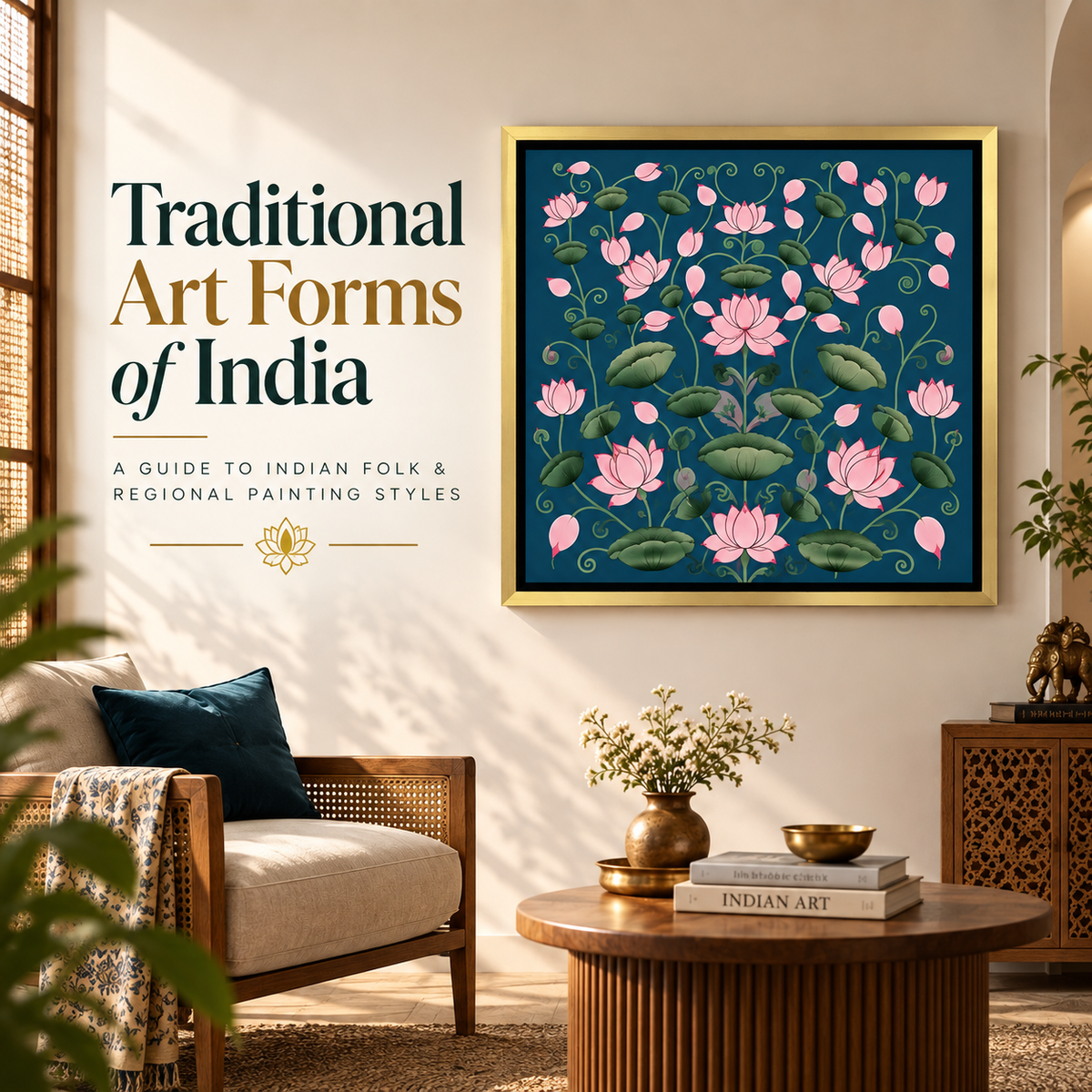
India's traditional art forms are not a single style but a living map of the country itself — a different visual language taking shape in almost every region, shaped by geography, faith, community life, and centuries of hand-me-down skill. Long before India had a single written history, its villages, temples, and royal courts were already recording their gods, harvests, and everyday lives on mud walls, cloth scrolls, and palm leaves.
Broadly, these traditions fall into three overlapping categories: folk art, made by rural communities as part of everyday and ritual life (Madhubani, Warli); tribal art, rooted in the beliefs and daily practices of indigenous communities (Gond, Warli again, Saura); and classical or court art, developed under royal or temple patronage with more formal technique and material richness (Tanjore, Kerala mural, miniature painting). The lines blur constantly — a single tradition can carry elements of all three — but the distinction is a useful starting point for understanding why a Warli painting looks nothing like a Tanjore one.
This guide walks through India's best-known traditional and folk painting styles: where each one comes from, how it's made, what it means, and how to spot the real thing. If you're looking to bring one of these traditions into your own home, you can browse our full hand-painted wall art collection alongside the guide.
India's Art, Region by Region
Because India's art traditions are so tightly tied to geography, it helps to start with a bird's-eye view. Rather than listing all 28 states individually (many share overlapping or lesser-documented traditions), here's how the major styles cluster by region:
| Zone | Key States | Notable Art Forms |
|---|---|---|
| North | Rajasthan, Uttar Pradesh, Punjab, Haryana, Delhi | Pichwai, Phad, Miniature painting |
| East | Bihar, West Bengal, Odisha, Jharkhand | Madhubani, Kalighat, Pattachitra, Manjusha |
| West | Maharashtra, Gujarat, Goa | Warli, Mata ni Pachedi, Rogan Art |
| South | Tamil Nadu, Andhra Pradesh, Telangana, Kerala, Karnataka | Tanjore, Kalamkari, Kerala mural, Chittara |
| Central | Madhya Pradesh, Chhattisgarh | Gond, Pithora |
| Northeast & Himalayan belt | Sikkim, Assam, Arunachal Pradesh, and surrounding states | Thangka painting and regional tribal art traditions |
North: Rajasthan alone carries two very different traditions — the devotional, richly detailed Pichwai of Nathdwara, and the narrative scroll paintings of Phad, traditionally performed and sung aloud by travelling bards. Add the Mughal-influenced miniature painting tradition, and North India's art history is really a story of courts, temples, and travelling storytellers.
East: Bihar's Madhubani painting and Bengal's Kalighat style both grew out of very different worlds — one from village women decorating home walls for weddings and festivals, the other from urban patua artists near Kolkata's Kalighat temple painting quick, bold souvenir images for pilgrims. Odisha contributes Pattachitra, an intricate cloth-scroll tradition centered on Jagannath temple iconography.
West: Maharashtra's Warli art is arguably India's most internationally recognisable tribal style — stark white geometric figures on an earthen red-brown ground. Gujarat adds Mata ni Pachedi (temple cloth painting) and Rogan Art, a rare technique using a thick, oil-based paste applied with a metal stylus.
South: This is India's most opulent painting belt. Tamil Nadu's Tanjore paintings use gold foil and gemstones over raised gesso work; Andhra Pradesh and Telangana's Kalamkari uses a bamboo pen and natural dyes on cotton or silk; and Kerala's temple mural tradition renders deities in bold, flat colour fields drawn directly from ancient wall paintings.
Central and Northeast: Madhya Pradesh's Gond art, built entirely from dots and lines, is one of India's most distinctive tribal styles, while the Himalayan belt's Thangka painting tradition — shared with Tibetan Buddhist practice — is used for meditation and religious instruction rather than home decor in its original context.
The Great Traditions of Indian Folk & Regional Painting
Madhubani Painting (Bihar)
Madhubani — also called Mithila painting, after the Mithila region of Bihar it comes from — is one of India's oldest and most recognisable folk art forms. Traditionally made by women, the style is said to date back to the time of the Ramayana, when King Janak is believed to have commissioned artists to decorate the town for his daughter Sita's wedding to Lord Rama.
The technique was originally done directly on freshly plastered mud walls and floors using fingers, twigs, and matchsticks dipped in natural dyes made from plant extracts, turmeric, and soot. Today it's more commonly painted on canvas, cloth, and handmade paper, though the visual grammar hasn't changed: bold outlines, no empty space left unfilled, and a double border framing the whole composition. Common motifs include the sun and moon, tulsi plants, fish (a symbol of fertility and good fortune), and scenes from Hindu mythology — Krishna, Rama, Durga, and wedding processions are recurring subjects.
To spot genuine hand-painted Madhubani work, look for slightly uneven line thickness (a sign of freehand brushwork rather than print), dense patterning with almost no blank canvas, and the characteristic double-line border running around the edge of the piece.
Explore our Madhubani painting collection for hand-painted pieces ranging from mythological scenes to nature-inspired motifs like the Tree of Life.
Warli Painting (Maharashtra)
Warli art comes from the Warli tribe, an indigenous community living along the Maharashtra-Gujarat border. Believed to be among India's oldest continuous painting traditions — some trace its roots back over 2,500 years — Warli art is instantly recognisable for what it leaves out as much as what it includes.
Unlike most Indian folk traditions, Warli paintings don't depict gods or mythological scenes. Instead, they capture everyday tribal life — farming, hunting, dancing, harvest celebrations — using only three basic shapes: the circle (representing the sun and moon), the triangle (mountains and trees), and the square (a sacred enclosure, often linked to the mother goddess Palaghata). Traditionally painted in white rice-paste on a base of mud, cow dung, and charcoal, the monochromatic, almost pre-historic quality of Warli art has drawn comparisons to cave paintings and Australian Aboriginal art.
Authentic Warli work should show a clear, spare compositional logic — figures built entirely from the same three geometric shapes, arranged in rhythmic, often circular patterns depicting a village scene rather than a single subject.
Our Warli art collection includes pieces suited to minimalist interiors, where the style's restraint tends to work best.
Pichwai Painting (Rajasthan)
Pichwai painting originates from Nathdwara in Rajasthan, home to the revered Shrinathji temple (a form of Krishna). The word "Pichwai" literally means "that which hangs from the back" — referring to the large cloth paintings traditionally hung behind the Shrinathji idol as a devotional backdrop, changed according to the season, festival, or time of day.
Pichwai work is dense, symmetrical, and richly detailed, most often depicting Shrinathji surrounded by cows (a recurring symbol of abundance and divine care), gopis, lotus ponds, and seasonal motifs like monsoon clouds or Diwali lamps. The Kamdhenu cow — a wish-fulfilling celestial cow from Vedic tradition — is another common subject, often painted with intricate gold detailing along the horns and body.
Genuine Pichwai art is identifiable by its fine, layered brushwork, warm devotional colour palette (deep reds, golds, and blues), and the sheer density of decorative detail — very little background is left unadorned.
Pichwai is one of our most extensive collections — browse the full Pichwai painting collection, or if you're specifically looking for Shrinathji devotional art for a home temple or pooja space, our dedicated Shrinath Ji painting collection is worth a look too.
Kalamkari Painting (Andhra Pradesh & Telangana)
Kalamkari — from "kalam" (pen) and "kari" (work) — is a textile-based art form practiced in Andhra Pradesh and Telangana, traditionally created using a bamboo or date-palm pen dipped in natural dyes. Two distinct schools exist: the Srikalahasti style, hand-drawn freehand and largely used for temple scrolls and mythological narratives, and the Machilipatnam style, which incorporates hand-carved wooden block printing alongside pen work.
The natural dye process is labour-intensive and distinctive to the craft — fabric is treated with buffalo milk and myrobalan (a natural astringent) before painting, then the artwork itself uses dyes derived from indigo, madder root, and pomegranate rind, with the fabric washed and sun-dried repeatedly between stages. Common motifs include peacocks, lotus flowers, and the "tree of life," alongside scenes from the Ramayana and Mahabharata.
Authentic Kalamkari work has a slightly organic, hand-drawn line quality (rather than the crisp uniformity of a printed pattern) and a muted, earthy colour palette that comes from natural rather than synthetic dyes.
See the full range in our Kalamkari painting collection, from florals to peacock motifs.
Tanjore Painting (Tamil Nadu)
Tanjore painting (or Thanjavur painting) developed under the patronage of the Maratha courts of Thanjavur in the 16th and 17th centuries, and remains one of India's most opulent classical art forms. Where most folk traditions on this list use flat pigment on cloth or paper, Tanjore painting builds physical texture into the surface itself — gesso work (a paste of chalk powder and gum) is raised and moulded to create relief detailing, then covered in genuine gold foil, with semi-precious stones sometimes inlaid directly into the composition.
Subjects are almost always devotional — Krishna, Ganesha, Shiva and Parvati, and other deities are depicted in full regal detail, with rounded faces, almond eyes, and symmetrical, formal compositions designed for worship as much as display. The gold work is what defines the style visually: it's meant to catch and hold light, giving the painting a glow that shifts through the day.
To identify genuine Tanjore work, look for actual raised texture under the gold areas (not just a flat gold-toned print) and check whether stones or embellishments, if present, are set into the surface rather than glued flat on top.
Our Tanjore painting collection includes pieces suited to pooja rooms and formal spaces alike.
Kerala Mural Painting (Kerala)
Kerala's mural tradition traces back over a thousand years to temple and palace wall paintings across the state, many of which still survive at sites like the Mattancherry Palace and various Kerala temples. Unlike Tanjore's gold-heavy opulence, Kerala mural art relies on bold, flat colour fields — deep reds, ochres, greens, and blacks — combined with intricate linework and elaborate crowns, jewellery, and floral backgrounds framing each figure.
The style follows strict traditional colour and proportion codes rooted in ancient texts on iconography, which is part of why Kerala mural figures have such a distinct, formal visual rhythm regardless of which artist paints them. Krishna, Radha, and Shiva-Parvati scenes are among the most common subjects, often set against a dense, decorative background of foliage and architectural motifs.
Look for the layered, almost sculptural quality of the linework and the characteristic colour restraint — Kerala mural art rarely uses gold in the way Tanjore does, relying instead on colour contrast and fine detail to create richness.
Browse the Kerala mural painting collection for devotional pieces rooted in this centuries-old South Indian tradition.
Kalighat Painting (West Bengal)
Kalighat painting emerged in 19th-century Kolkata, named after the Kalighat Kali Temple where the style first developed. Unlike most traditions on this list with roots going back centuries in rural life, Kalighat art has a distinctly urban origin story — local patua (scroll-painting) artists began producing quick, bold, inexpensive paintings for pilgrims visiting the temple, using flowing brushstrokes and minimal detail to work fast at scale.
The style is known for its confident, sweeping linework, bold outlines, and simplified but highly expressive figures — a deliberate departure from the dense, ornamental style of many other Indian traditions. Subjects ranged from religious icons and mythological figures to, later, sharp social satire commenting on colonial-era Bengali society, making Kalighat one of the more politically engaged folk art traditions in Indian history.
Genuine Kalighat work is defined by its economy of line — a few confident brushstrokes doing the work that other traditions might use dense patterning for. The style rewards restraint rather than intricacy.
See the full Kalighat painting collection for a bolder, more graphic take on Indian folk art.
Pattachitra Painting (Odisha)
Pattachitra — meaning "cloth picture" — is a centuries-old scroll painting tradition from Odisha, closely tied to the Jagannath Temple in Puri. Traditionally painted on cloth stiffened with a tamarind-seed paste and chalk powder, Pattachitra artists use natural pigments and a fine brush to render intricate, densely detailed scenes, almost always featuring elaborate decorative borders.
The most iconic subject in Pattachitra is the Jagannath Trinity — Jagannath, Balabhadra, and Subhadra — depicted in their distinctive stylised form with large, round eyes and simplified limbs. Krishna Leela scenes (episodes from Krishna's life) and other mythological narratives are also common, often composed in horizontal panels that read like a visual story.
We currently carry a single, striking Pattachitra piece: the Jagannath Trinity, one of the tradition's most iconic and instantly recognisable compositions. If you're drawn to Odisha's temple art traditions more broadly, our spiritual hand-painted collection includes other devotional styles that pair well with it.
Other Regional Art Forms Worth Knowing
Gond Art (Madhya Pradesh)
Gond art comes from the Gond tribe, one of India's largest indigenous communities, spread mainly across Madhya Pradesh and neighbouring states. The style is built almost entirely from an intricate vocabulary of dots, dashes, and fine lines, layered together to build texture, movement, and rhythm into depictions of animals, trees, and folk deities. Gond artists traditionally believed that a good image "creates luck," and the tradition remained largely a village practice until the artist Jangarh Singh Shyam brought it to wider recognition in the 1980s, sparking a generation of Gond artists working on paper and canvas. The style today is prized for its vivid colour use and hypnotic, patterned surfaces — every animal or figure seems to be made of moving texture rather than solid form.
Phad Painting (Rajasthan)
Phad is a Rajasthani scroll-painting tradition built around performance as much as visual art. Long cloth scrolls, painted in bold reds, yellows, and oranges, depict the epic stories of local folk deities — particularly Pabuji and Devnarayan — along with battle scenes and legendary romances. Traditionally, a Bhopa (priest-singer) would unroll the Phad scroll at night and sing the depicted story aloud to a village audience, using the painting as a visual score for an oral performance that could run for hours. Today Phad scrolls are also collected as standalone artworks, but the composition still carries the structure of that original storytelling function — multiple episodes unfolding across a single continuous scene.
A Few More Traditions Across India
- Cheriyal Scroll Painting (Telangana): Narrative scroll paintings traditionally used by travelling storytellers, known for vivid primary colours and stylised, theatrical figures.
- Mata ni Pachedi (Gujarat): Hand-painted temple cloths depicting the mother goddess, traditionally used as portable shrines by communities without access to formal temples.
- Rogan Art (Gujarat): An extremely rare technique using a thick, castor-oil-based paste applied with a metal stylus rather than a brush — practiced today by only a handful of families in Kutch.
- Kavad (Rajasthan): Painted wooden shrines with hinged doors that open to reveal nested storytelling panels — part sculpture, part portable temple.
- Pithora (Gujarat & Madhya Pradesh): Tribal ritual wall paintings created as part of specific ceremonies, often depicting horses, the sun, and ancestral spirits.
- Manjusha (Bihar): A folk art tradition tied to the Bihula-Bishahari folklore, painted on boxes and scrolls with a distinctive angular, linear style.
- Chittara (Karnataka): Geometric wall art from the Deewaru community, traditionally made using rice paste on mud walls for weddings and festivals.
- Thangka (Himalayan belt): Buddhist scroll paintings used for meditation and religious instruction, sharing techniques with Tibetan Buddhist art traditions.
Indian Art Forms at a Glance
A quick list of the traditions covered in this guide, if you're looking for a specific style:
- Madhubani — Bihar
- Warli — Maharashtra
- Pichwai — Rajasthan
- Kalamkari — Andhra Pradesh / Telangana
- Tanjore — Tamil Nadu
- Kerala Mural — Kerala
- Kalighat — West Bengal
- Pattachitra — Odisha
- Gond — Madhya Pradesh
- Phad — Rajasthan
Prefer to browse by style rather than read through? Our traditional art painting collection groups several of these together in one place.
Frequently Asked Questions
How many traditional art forms are there in India?
Estimates vary widely depending on how narrowly "art form" is defined, but India is home to several hundred documented painting, textile, and craft traditions across its states and union territories — ranging from widely known styles like Madhubani and Warli to highly localised traditions practiced by only a handful of families today.
What's the difference between folk art and tribal art?
Folk art generally refers to traditions practiced by rural or village communities as part of everyday and festival life (Madhubani, Kalighat), while tribal art specifically comes from India's indigenous (Adivasi) communities and is often tied to animistic beliefs and rituals rather than mainstream Hindu iconography (Warli, Gond). In practice, the categories overlap significantly.
What is the oldest Indian art form?
Warli painting is often cited as one of India's oldest continuous traditions, with roots that some scholars trace back over 2,500 years, though prehistoric rock art (such as the Bhimbetka rock shelters) predates any of the named painting traditions on this list by tens of thousands of years.
Which Indian art form is most recognised internationally?
Madhubani and Warli tend to be the most widely recognised outside India, partly due to decades of government cultural promotion and their strong, distinctive visual identities that translate easily to textiles, stationery, and modern decor.
How can I tell if a piece of folk art is hand-painted rather than printed?
Look closely at the linework: hand-painted pieces show slight natural variation in line thickness and pressure, small imperfections in symmetry, and visible brush or pen texture, whereas printed reproductions have perfectly uniform lines and flat, unvarying colour with no texture under close inspection.
Which Indian traditional paintings are most popular right now?
Pichwai and Tanjore paintings tend to be especially popular for home decor and pooja spaces given their devotional themes and rich detailing. You can see what's currently trending across all styles in our best-selling wall art collection.
Choosing Handmade Indian Wall Art for Your Home
A few things worth considering before you buy:
Materials and technique: Genuine hand-painted work will show natural variation up close — slightly uneven brushstrokes, minor asymmetries, visible texture. This isn't a flaw; it's the clearest sign you're looking at an actual painting rather than a print.
Sizing for your space: Devotional styles like Pichwai and Tanjore tend to work well as a single statement piece above a console or in a pooja space, while more graphic, minimal styles like Warli and Kalighat can work well in pairs or small groupings on a gallery wall.
Care: Keep hand-painted canvas art out of direct, prolonged sunlight to preserve colour vibrancy over time, and dust gently with a dry, soft cloth rather than any liquid cleaner.
If you'd rather browse than read, our full ethnic wall art collection brings every tradition in this guide together in one place — or, if your taste runs more contemporary, our modern hand-painted collection offers a different take on hand-painted wall art altogether.