
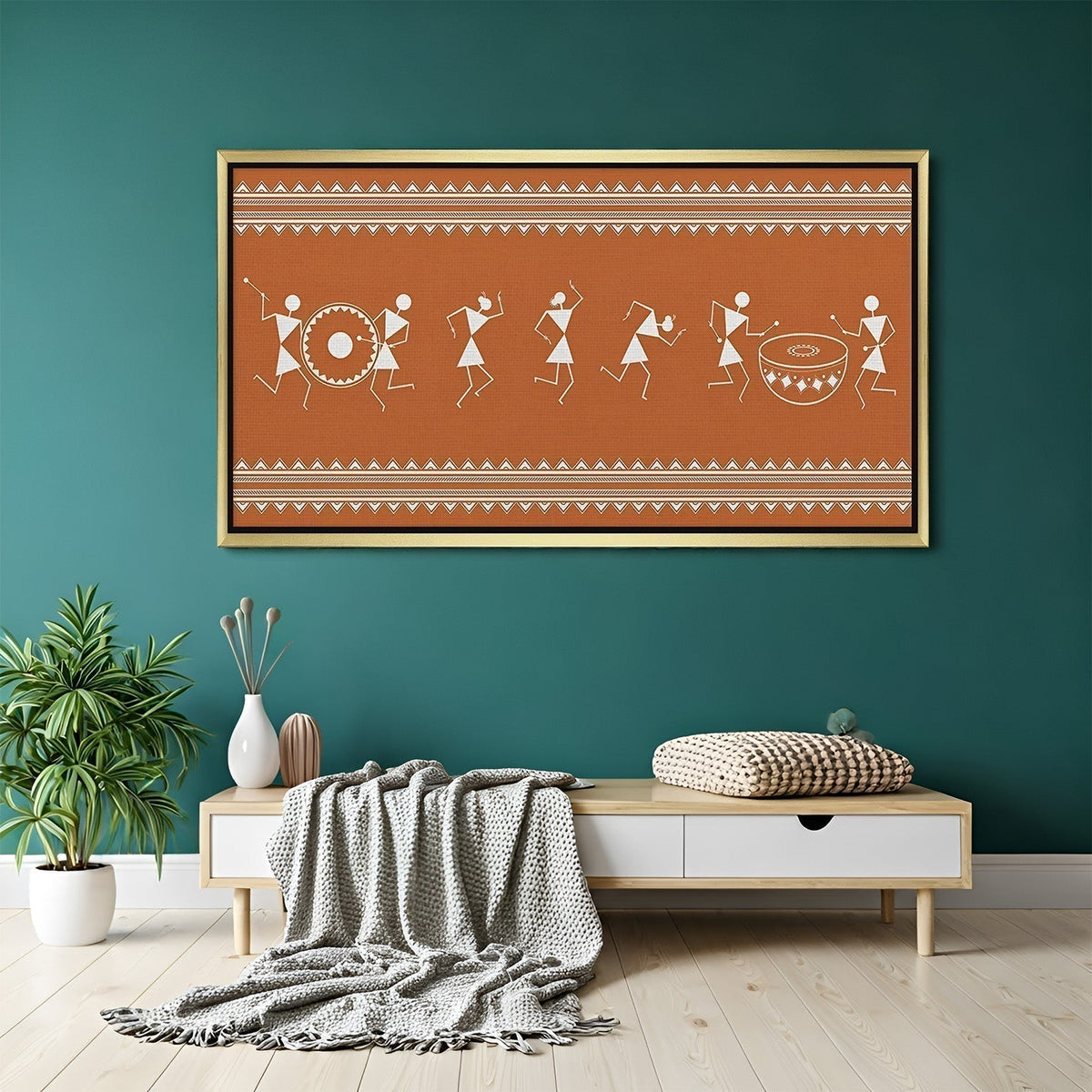
Warli art can be an excellent choice for home interiors if you want artwork that feels culturally rooted without overwhelming a modern space. Its earthy palette, geometric figures and scenes of village life, farming, dance, animals and nature make it suitable for living rooms, bedrooms, offices and transitional spaces.
Warli painting originated as a wall-painting tradition among Warli communities in western India, particularly Maharashtra. Traditional paintings were created on prepared mud walls using white pigment made from rice flour and water. Today, the visual language of Warli has also been adapted to paper and canvas, allowing the style to work in contemporary interiors.
This guide explains what Warli art means, popular Warli painting designs, where to place it at home, how it works with modern decor, how to choose the right size and frame, and what to know about Warli art and Vastu.
What is Warli art?
Warli is a traditional tribal wall-painting practice associated with the Warli community of Maharashtra and neighbouring regions.
Traditional Warli paintings were made on walls coated with clay and cow dung and finished with red earth, producing the characteristic terracotta-brown background. The figures were painted in white using a mixture traditionally made from rice flour and water.
One of Warli art's most recognizable features is its ability to build complex scenes using extremely simple forms.
- Circles are used for heads and other natural forms.
- Triangles combine to create human and animal bodies.
- Squares or rectangular forms appear particularly in ritual compositions.
- Lines and repeated figures create movement, dance and community scenes.
Rather than relying on elaborate perspective or realistic anatomy, Warli painting uses these basic forms to tell stories about community life.
What does Warli art represent?
There is no single meaning shared by every Warli painting. The subject depends on the type of composition and the occasion for which it was traditionally created.
Common Warli scenes depict:
- farming and harvesting
- community celebrations
- traditional dances
- weddings and ritual activity
- hunting and fishing
- trees, birds and animals
- village life and everyday work
- the relationship between people and their natural surroundings
Some traditional Warli paintings were ritual works associated with events such as marriage, while others were decorative. That distinction is important: not every tree, bird or animal in a modern Warli composition should automatically be assigned a fixed spiritual or Vastu meaning.
Why does Warli art work so well in modern homes?
Warli art has an unusual advantage in contemporary interiors: although its visual language is traditional, its geometry and limited colour palette can look remarkably modern.
Earthy colours are easy to style
Traditional white-on-brown Warli compositions work naturally with:
- white and ivory walls
- warm beige and greige interiors
- natural wood furniture
- terracotta accents
- cane, rattan and jute
- linen and cotton furnishings
- black metal or dark wood details
This makes Warli particularly easy to integrate into modern Indian, rustic, boho and understated contemporary interiors.
Geometric forms feel contemporary
Warli figures are constructed using circles, triangles and rhythmic linework. From a distance, those repeated geometric patterns can read almost like contemporary graphic art.
That allows a traditional Warli composition to work in a modern apartment without making the room feel excessively ornate or ceremonial.
The artwork tells a story without visual clutter
Warli paintings frequently show groups of people dancing, farming, gathering or celebrating. There can be a great deal happening within the artwork, but the restrained palette keeps the overall composition visually controlled.
That balance makes Warli especially useful when you want art with cultural depth but do not want very bright colours or heavily detailed decorative motifs.
Popular Warli painting designs for home
Modern Warli wall art comes in many compositions. Rather than choosing solely by colour, look at the story and movement within the artwork.
1. Village and community scenes
Village scenes are among the most recognizable Warli-inspired compositions. They may include people working, gathering, carrying objects, interacting with animals or participating in communal activities.
These designs work particularly well in living rooms and large common spaces because there is enough viewing distance to appreciate the individual figures.
2. Dance and celebration scenes
Dance scenes bring more movement into the composition. The repeated figures and circular arrangements create strong visual rhythm while retaining Warli's simple geometry.
They can work well on a large living-room wall, dining area or creative workspace where you want the artwork to feel lively rather than meditative.
3. Farming, trees and nature-inspired scenes
Agriculture and nature are recurring parts of Warli visual culture. Modern canvas designs may incorporate trees, animals, fields and people working within the landscape.
These are particularly versatile for homes because the imagery feels organic and grounded without relying on overt religious symbolism.
4. Wedding and ceremonial scenes
Marriage has an important place in traditional Warli wall painting. Historical ritual compositions could depict the bride and groom, community activity and sacred motifs associated with the ceremony.
Modern decorative Warli canvases inspired by weddings or processions can therefore carry a strong sense of celebration and community, although a printed canvas should not be confused with an original ritual wall painting.
5. Minimal and geometric Warli compositions
If your home is highly contemporary, look for Warli artwork with stronger negative space and fewer figures.
Minimal compositions retain the characteristic geometric visual language while making the artwork easier to integrate with Scandinavian, Japandi, modern-minimal or neutral interiors.
Where should Warli wall art be placed at home?
There is no single room in which Warli art must be displayed. Because it is available in both busy narrative compositions and quieter minimal styles, placement should depend primarily on the artwork's scale, level of detail and the mood of the room.
Living room
The living room is one of the strongest locations for Warli art, particularly for a large narrative canvas.
A wide or square Warli composition can work:
- above a sofa
- on a feature wall
- above a console
- between architectural openings
- as part of a culturally themed gallery wall
Because Warli artwork contains fine linework and small figures, a larger piece usually creates more impact in a spacious room than several unrelated small canvases.
Bedroom
Warli can work in a bedroom when the composition is relatively calm rather than densely packed with movement.
Look for:
- nature-led compositions
- smaller community scenes
- minimal geometric Warli artwork
- earthy neutral palettes
A horizontal canvas above the headboard or a single portrait-oriented piece beside the bed can introduce cultural character without visually crowding the room.
For broader room-specific advice, see our Bedroom Wall Art collection.
Dining room
Warli works particularly naturally in dining spaces because many compositions focus on community, gathering, celebration and everyday social life.
A wide narrative canvas on the main dining wall can complement wooden furniture, warm lighting and earthy textiles without competing with the dining setting.
Home office or study
A restrained Warli canvas can add visual interest to a workspace without relying on bright colours or oversized typography.
Square and portrait compositions work particularly well above a desk, cabinet or reading area.
See our Office Wall Art collection for other artwork suited to professional spaces.
Entryway and hallway
A Warli panel can create a distinctive first impression in an entrance or hallway because the artwork rewards closer viewing.
Long horizontal or narrow vertical formats work especially well in transitional areas where a very colourful artwork might feel overwhelming.
Is Warli painting good according to Vastu?
Warli painting and Vastu Shastra are separate traditions. Warli is an artistic and cultural practice, while Vastu concerns the organization and symbolic interpretation of spaces.
Modern home-decor advice sometimes combines the two, particularly because Warli art frequently depicts nature, community, agriculture and harmonious social activity. However, there is no single traditional Warli rule stating that a particular Warli motif must be placed in a specific compass direction.
If you want to incorporate Warli artwork into a Vastu-conscious home, a practical approach is to focus on:
- positive or peaceful subject matter
- a room appropriate to the artwork's mood
- a clean, well-maintained display area
- appropriate scale for the wall
- the directional guidance for that particular room or wall, rather than inventing a Vastu meaning for the Warli motif itself
For example, if your Warli painting is being placed on a south-facing wall, use the guidance for that wall direction rather than assuming Warli artwork has one universal Vastu placement.
For broader directional principles, see our Vastu Wall Art Rules guide.
Does Warli art bring prosperity or positive energy?
Warli paintings are sometimes marketed with claims about prosperity, luck or positive energy. It is better to distinguish those modern interpretations from the documented cultural tradition.
Warli art certainly depicts subjects such as community, agriculture, marriage, celebration, animals and the natural world. Those themes may feel harmonious, joyful or grounded to a viewer, but the painting itself should not be treated as a guarantee of prosperity or a particular life outcome.
If you choose Warli artwork for your home, its strongest value lies in its cultural story, visual rhythm and ability to connect a modern interior with an important Indian folk-art tradition.
How to choose the right Warli painting size
Warli compositions often contain many small figures, so size matters more than it does with very simple artwork.
| Location | Useful size range | Why it works |
|---|---|---|
| Large sofa or feature wall | 36×48", 48×48" or wide landscape formats | Provides enough scale to appreciate detailed village and community scenes |
| Bedroom accent wall | 24×36" to 30×48" | Creates a focal point without overwhelming the room |
| Home office or study | 24×24" to 36×36" | Works above a desk, shelf or cabinet |
| Hallway or entryway | 18×24", portrait format or narrow landscape | Fits tighter walls while preserving enough detail |
| Large statement wall | 48" and above | Allows intricate Warli storytelling to be read from a distance |
These are interior-design starting points rather than fixed rules. Always measure the actual wall and furniture before selecting a size.
How wide should Warli art be above a sofa?
As a practical styling guideline, artwork spanning approximately 60–75% of the sofa's width often produces a balanced composition.
A very small Warli canvas above a large sofa may make the intricate figures difficult to appreciate and can leave the wall looking visually unfinished.
Which frame works best with Warli art?
The right frame depends on whether you want Warli to feel more contemporary or more decorative.
Canvas wrapped
Canvas-wrapped artwork gives Warli a clean, modern presentation and works especially well in minimal interiors where you do not want a visible frame competing with the artwork.
Black floater frame
A black floater frame emphasizes the strong contrast and geometry of Warli figures. It works particularly well with white, grey and neutral walls and gives traditional imagery a contemporary finish.
Golden floater frame
A golden frame introduces more warmth and decorative presence. It can suit traditional Indian interiors, warm wooden furniture and spaces where the artwork is intended to feel more formal.
Warli vs Madhubani, Pichwai and Kalamkari
If you like Indian folk and traditional art but are unsure which style fits your home, the visual differences are significant.
| Art style | Visual character | Typical visual effect | Works especially well in |
|---|---|---|---|
| Warli | Geometric figures and narrative village scenes | Earthy, restrained, graphic | Minimal, boho and modern Indian interiors |
| Madhubani | Dense patterns, figures, flora and decorative borders | Detailed and colourful | Eclectic, festive and expressive interiors |
| Pichwai | Krishna-related devotional imagery, lotuses and ornate compositions | Rich and decorative | Traditional, spiritual and luxurious interiors |
| Kalamkari | Detailed figurative and narrative imagery | Craft-oriented and intricate | Traditional and heritage-inspired spaces |
Choose Warli when you want cultural storytelling with a more restrained palette and geometric character.
For alternatives, explore our Madhubani Wall Art, Pichwai Wall Art and Kalamkari Wall Art collections.
How to style Warli wall art in a modern interior
Warli does not require an entirely traditional room around it. In fact, contrast is often what makes it effective.
Try pairing Warli artwork with:
- warm white, ivory or greige walls
- walnut or natural wood furniture
- terracotta or rust-coloured cushions
- linen upholstery
- jute or natural-fibre rugs
- black metal accents
- warm indirect lighting
- simple pottery and handcrafted objects
Avoid surrounding a detailed Warli canvas with too many competing decorative objects. Giving the artwork some negative space makes the figures and narrative easier to read.
Frequently asked questions about Warli wall art
What is Warli art?
Warli is a traditional tribal painting practice associated with Warli communities in western India. It is known for white geometric figures painted traditionally on earthy wall surfaces and for scenes of community life, farming, celebrations, animals and nature.
Is Warli painting good for home?
Yes. Warli art works particularly well in homes because its earthy colours and geometric visual language can complement both traditional and contemporary interiors.
What do Warli paintings depict?
Common subjects include farming, dancing, weddings, hunting, fishing, animals, trees, village activities and other aspects of community and everyday life.
What do the geometric shapes in Warli art mean?
Triangles, circles, squares and lines form the basic visual language used to construct humans, animals, ritual elements and narrative scenes. Their role can vary depending on the composition.
Is Warli art suitable for a living room?
Yes. The living room is particularly suitable for larger Warli canvases because detailed narrative scenes benefit from both wall space and viewing distance.
Can Warli paintings be used in a bedroom?
Yes. Choose a quieter or more minimal Warli composition for bedrooms so that the detailed figures do not make the room feel overly busy.
Can Warli art be used in an office?
Yes. Its restrained colours and geometric patterns can work particularly well in home offices, studies and professional interiors.
Does Warli painting have Vastu significance?
Warli and Vastu are separate traditions. Contemporary decor advice sometimes combines them, but there is no universal traditional Warli rule assigning every motif to a specific Vastu direction.
Which direction is best for a Warli painting?
There is no single direction that applies to every Warli composition. If you follow Vastu, consider the room, wall direction and subject separately rather than assuming Warli art itself has one compulsory placement.
Are Warli canvas paintings the same as traditional Warli wall paintings?
No. Traditional Warli painting was created directly on prepared walls using locally available materials. Canvas versions adapt the characteristic visual language and motifs into a format suitable for modern interiors.
Which frame is best for Warli wall art?
Canvas wrapped works well for minimal interiors, black floater frames give Warli a contemporary graphic finish, and golden floater frames create a warmer, more decorative presentation.
What colours go well with Warli art?
White, ivory, beige, greige, natural wood, terracotta, rust and muted earthy shades generally complement Warli's traditional brown-and-white visual character.
Choosing Warli art for your home
The strongest reason to choose Warli artwork is not a promise of luck or prosperity. It is the combination of cultural storytelling, geometric simplicity, earthy colour and everyday human narratives that gives the style its lasting appeal.
For a living room, consider a larger narrative canvas. For bedrooms and workspaces, quieter compositions or more restrained formats may work better. Choose the frame and size according to the interior rather than treating Warli as a one-style-fits-all category.
Explore our Warli Wall Art collection to compare Warli-inspired canvas paintings across different sizes, orientations and frame options.