
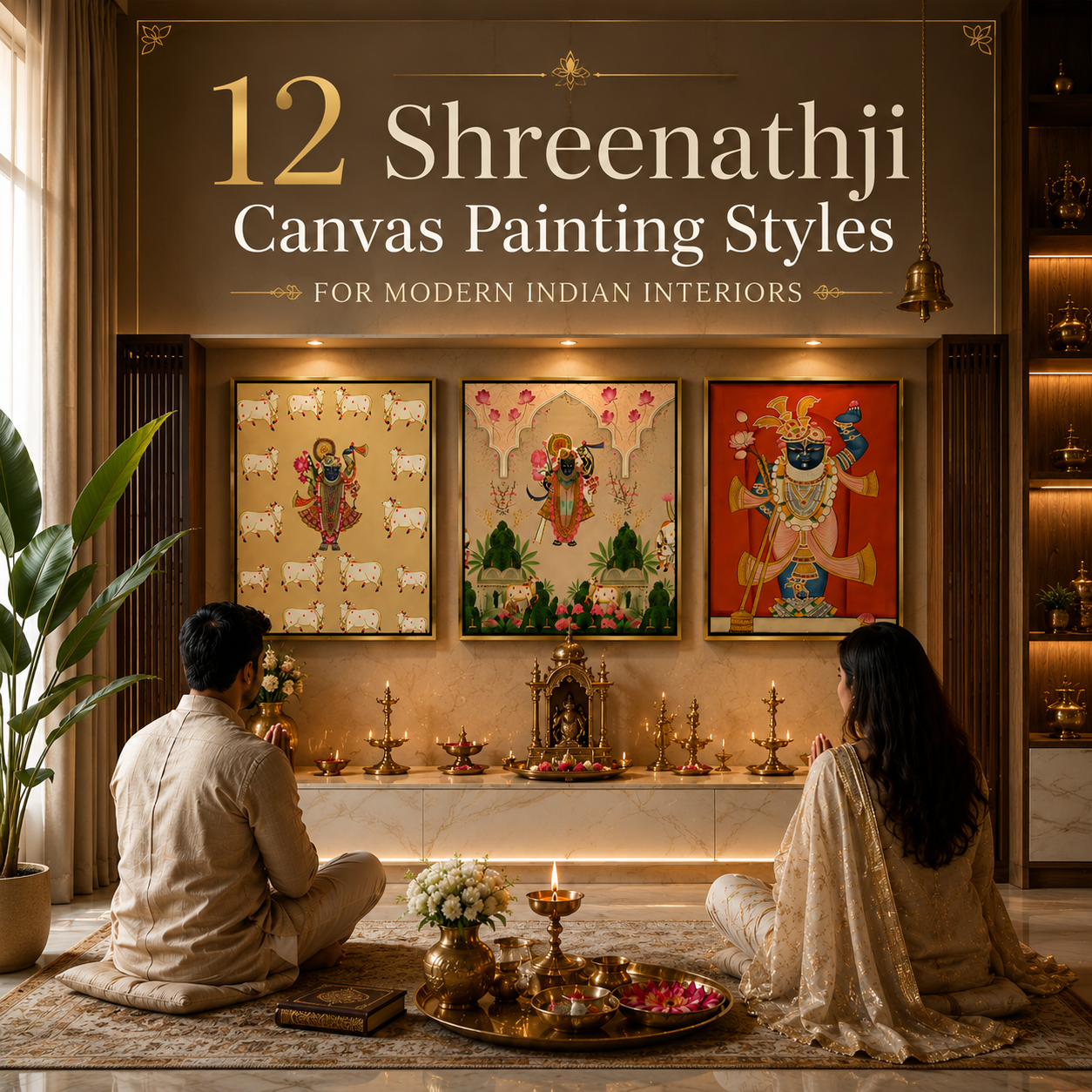
There is something quietly powerful about a Shreenathji painting on canvas. It doesn't announce itself the way a bold abstract does. It settles into a room. Over time, it becomes part of the home's personality - a presence rather than a decoration.
Lord Shreenathji, the child form of Krishna with his arm raised to hold the Govardhan hill, has inspired devotional art for centuries. But the way this divine image is being interpreted today - on canvas, in Pichwai traditions, in rich jewel tones and minimal frames - fits surprisingly well into contemporary Indian homes that want depth, not just aesthetics.
If you're trying to find the right Shreenathji painting for your space, this guide breaks down twelve distinct styles, what makes each one work, and where it belongs in a home.
Why Shreenathji Canvas Art Has Found a Place in Modern Homes
Most families in India have some connection to Shreenathji - whether through the Nathdwara temple, Vaishnavite traditions, or simply a grandmother's puja room. That personal lineage is part of why these paintings carry weight that other wall art doesn't.
But the shift from framed print to canvas wall art has changed the conversation. A high-quality canvas print reproduces the intricate detail of Pichwai art - the foliate borders, the cows, the lotuses - without the fragility of paper or the coldness of a glass frame. It hangs flush, reads as art, and ages well on a wall.
That practical shift is one reason. The other is that more Indian homeowners are actively moving away from generic decor and returning to cultural roots. A Shreenathji painting on canvas does what a lot of minimalist imported art can't: it holds meaning.
The 12 Shreenathji Canvas Painting Styles Worth Knowing
1. Classic Pichwai Style
Pichwai literally means "that which hangs behind" - these paintings were traditionally hung behind the idol of Shreenathji in temples. The visual language is specific: lotus ponds, cows, maids with lamps, and a central divine figure surrounded by floral symmetry.
On canvas, this style is among the most detailed you'll find. The rich navy and gold palette feels almost regal. It works beautifully in a living room with warm lighting, where the layered composition gives viewers something new to discover each time.
Browse the Shreenathji Pichwai canvas collection if this is the direction you're leaning - there are several colour variations including navy, black, and saffron.
2. Navy Royal Pichwai
Among colour variants, the deep navy background is perhaps the most dramatic. Against that dark field, the gold detailing of Shreenathji's ornaments and the soft ochre tones of the cows create a contrast that's genuinely striking.
Navy Pichwai paintings work particularly well in homes with white or off-white walls. The painting becomes the room's anchor. Pair it with brass or copper accents and warm-toned textiles to bring the composition into the space.
3. Shreenathji Heritage Pichwai
Heritage Pichwai sits somewhere between the classical temple tradition and the more decorative interpretations that have emerged in recent decades. The compositions are older in feeling — less symmetrical than modern Pichwai, with a rawness in the brushwork that points back to the painters who first developed this art form in the lanes around Nathdwara.
The palette tends toward aged tones: muted golds, dusty ochres, weathered reds. Nothing is too bright. The overall effect is of something that has been around for a long time — which, in a home context, is exactly the quality some people are looking for.
Heritage Pichwai works particularly well alongside antique furniture, old wood, handwoven textiles, and collected objects. It doesn't need a curated interior — in fact it often looks better in spaces with some history and patina to them.
4. Orange Pichwai
Saffron and orange are colours of deep spiritual significance in Indian tradition, and a Shreenathji painting rendered in orange-gold tones has a warmth that few other colour palettes achieve. It doesn't just hang on the wall - it radiates.
This works well in pooja rooms, obviously, but also in dining areas and entrance foyers where a welcoming energy matters. The saturation can be high, so balance it with neutral surroundings rather than competing colours.
5. Green Pichwai
Forest green backgrounds bring a quieter, more contemplative mood to Shreenathji art. The earthy undertones recall Vrindavan's lushness - the forests where Krishna tended his cows. It feels natural rather than ceremonial.
Green Pichwai canvases tend to feel more at home in bedrooms, reading corners, and meditation spaces. They're one of the styles that transitions most easily between a purely spiritual context and a lifestyle-interior setting.
6. Shreenathji with Sacred Cows (Gau Seva)
Cows hold a central place in Shreenathji iconography - they're always present in Pichwai compositions. But paintings specifically themed around Gau Seva (care for cows) carry an additional layer of meaning: abundance, nurturing, the reciprocal relationship between the divine and the living world.
In terms of visual composition, these paintings tend to be horizontal and spacious, with Shreenathji flanked by cows in a processional arrangement. They suit wide walls - above a console in a hallway, or behind a sofa on a long living room wall.
The Shreenathji Gau Seva Pichwai is one of the more emotionally resonant pieces in this range, and it's frequently chosen as a housewarming gift.
7. Lotus Pichwai
The lotus motif in Shreenathji art carries a specific spiritual meaning - purity arising from muddy waters, divine detachment. Paintings where lotus ponds and blossoms dominate the background bring a meditative visual rhythm.
Lotus Pichwai canvases are among the most popular for pooja rooms because of their layered spiritual meaning. But they also work in bathrooms with spa-like aesthetics and bedrooms where calm is the design priority.
8. Traditional Nathdwara Style
Nathdwara, the town in Rajasthan where the principal Shreenathji temple stands, has its own distinct painting tradition. Artists there have been rendering this divine form for generations, and the style carries specific gestures, garments, and compositional rules passed down through lineages of painters.
A traditional Nathdwara-style Shreenathji canvas on canvas is essentially a reproduction of that living heritage. The colours tend to be earthier - muted golds, rust tones, aged ivory - and the figure of Shreenathji is more formally rendered than in contemporary interpretations.
This style suits homes that lean toward heritage aesthetics: old wood furniture, handwoven textiles, terracotta accents. It doesn't need to be a "traditional" home in the rigid sense - even modern apartments with eclectic, layered decor can carry this kind of painting powerfully.
9. Rajasthani Heritage Style
Distinct from pure Pichwai, Rajasthani heritage-style Shreenathji paintings often incorporate broader folk motifs - elephants, parrots, folk patterns from Rajput miniature tradition. The palette is festive and full.
These are the paintings that feel celebratory. They suit spaces where there's visual energy already - a patterned rug, colourful cushions, layered decor. They don't require silence around them.
10. Black Royal Pichwai
A black background is unusual in traditional Pichwai, which makes the black royal variant particularly striking in contemporary settings. Against the deep black field, gold and white detailing takes on an almost luminescent quality.
Interior designers have started reaching for this variant when working on luxury apartments and high-end hospitality spaces. It reads as sophisticated rather than religious, which makes it versatile for spaces where the homeowner wants cultural reference without overt devotional display.
11. Divine Vastu Shreenathji
Vastu-inspired Shreenathji paintings are designed with energy flow and placement in mind - they're meant to be hung in specific positions to bring positive vibrations into a space. The compositions are typically frontal, symmetrical, and visually stable.
For homeowners who approach decor holistically - where placement, direction, and energy all matter alongside aesthetics - a Vastu Shreenathji canvas offers something others don't. It comes with intention built in.
12. Large Format Pichwai (24×36 and Beyond)
There's a scale at which these paintings stop being decorative objects and become genuinely immersive. At 24×36 inches and above, a Shreenathji Pichwai canvas becomes a focal wall in its own right.
Large-format pieces work in living rooms with high ceilings, open-plan dining areas, and entrance lobbies. The detail that might be lost at smaller sizes becomes fully readable - the lotus textures, the fine linework on the deity's ornaments, the gradations in the background wash.
If you're buying for a large wall and want something that commands the space without feeling busy, a 36×48 inch Shreenathji Pichwai in a floater frame is worth considering seriously.
Floater Frame vs Canvas Wrapped: What Actually Looks Better

This comes up constantly, and the honest answer is that it depends on the wall and the room.
Canvas wrapped (where the image extends around the sides of the stretcher frame) gives a clean, gallery-wall aesthetic. There's no frame to break the composition. It suits homes that lean minimalist or where the painting is one of several on a gallery wall.
Floater frames - particularly black or gold - give the painting a finished, framed quality that reads as more formal. A black floater frame suits contemporary and transitional interiors. A gold floater frame adds grandeur, which suits larger pieces and more traditionally appointed rooms.
For Pichwai specifically, the black floater frame has become something of a default recommendation because it echoes the dark, deeply saturated backgrounds of many Pichwai compositions without competing with them.
Where to Hang a Shreenathji Canvas in Your Home
The placement question deserves more thought than it usually gets.
- Pooja room: The obvious choice, and for good reason. A Shreenathji painting on the wall above or beside the altar creates a continuous devotional atmosphere. Choose the lotus or traditional Nathdwara style for this placement.
- Living room, north or east wall: According to Vastu principles, divine imagery placed on the north or east wall invites positive energy. Practically, these walls often catch morning light, which brings out the gold detailing in Pichwai paintings beautifully.
- Entrance foyer: A Shreenathji painting as the first thing guests see sets the tone for the whole home. Choose a medium-to-large format here - something that reads clearly from a distance.
- Bedroom: A quieter, more contemplative Shreenathji - the green or lotus variant - works well as bedroom wall art, particularly above a console or on the wall across from the bed.
- Home office or study: A smaller canvas (18×24 inches) placed at eye level while seated brings a grounding energy to a workspace. The Vastu variant is specifically designed with this intention.
Gifting a Shreenathji Painting: What to Think About
These paintings are among the most thoughtful housewarming and wedding gifts in Indian tradition - they carry spiritual significance, cultural meaning, and genuine aesthetic value, which is a rare combination in a gift.
When choosing a Shreenathji canvas painting as a gift, it helps to think about the recipient's aesthetic. A family with traditional decor will likely appreciate the Nathdwara or orange Pichwai styles. A younger couple in a modern apartment might respond more to the black royal or navy variants, which are visually dramatic without being overtly devotional in their immediate reading.
Size matters more than people expect. A 12×18 inch canvas feels personal and intimate. A 24×36 inch canvas is a statement piece - appropriate for a housewarming gift for a close family member, less so as a casual gesture.
At Cipher Spaces, each painting is made to order on 380 GSM canvas with long-lasting print quality, so you're giving something built to last on a wall for years.
Common Questions About Buying Shreenathji Canvas Art
What size Shreenathji painting works best for a living room?
For most living rooms, 24×36 inches is the sweet spot - large enough to be a focal piece, not so large that it overwhelms the wall. For rooms with very high ceilings or long accent walls, 36×48 inches creates a more dramatic effect. A common mistake is choosing a size that looks large in a product photo but reads as small on an actual wall.
Is canvas better than a framed print for Pichwai art?
Canvas reproduces the texture and depth of Pichwai compositions better than paper prints. The slight texture of canvas gives the painting a tactile quality that echoes the original textile-based form of Pichwai art. It also doesn't catch light the way glass does, so it remains readable from multiple angles in a room.
Can Shreenathji paintings be placed in non-devotional spaces?
Yes, and increasingly they are. The visual language of Pichwai is rich enough to work as fine art in any context. In spaces like home offices, dining rooms, and even high-design lobbies, a Shreenathji Pichwai canvas adds cultural depth and visual complexity without requiring the space to be arranged around it devotionally.
What is the significance of cows in Shreenathji paintings?
Cows are inseparable from Shreenathji iconography. They represent abundance, nurturing, and the pastoral life of Vrindavan. In Pichwai compositions, cows are always present - sometimes as small repeated motifs, sometimes as prominent figures flanking the deity. Their presence is considered auspicious.
How do I care for a canvas painting?
Canvas paintings require minimal maintenance. Keep them away from direct sunlight to prevent colour fading over time. Dust gently with a dry, soft cloth. Avoid moisture exposure. Unlike paper-based art, canvas doesn't require glass protection, which makes long-term care simpler.
A Note on Craftsmanship
The best Shreenathji canvas paintings aren't just reproductions - they're interpretations. The choice of colour palette, the emphasis given to particular elements in the composition, the quality of the print itself - all of this shapes what the painting actually feels like on a wall.
Cipher Spaces prints on 380 GSM canvas with inks and processes designed for long-term colour integrity. Every piece is made to order, which means no warehouse stock sitting under fluorescent lights. The painting that arrives has been produced specifically for you.
That's not a small thing. Mass-market art often looks fine in product photography and disappointing in person. A made-to-order canvas - properly stretched, well-printed, carefully packaged - arrives ready to hang and designed to hold its quality over years.
Explore Other Collections from Cipher Spaces
If Shreenathji wall art resonates with you, these related collections are worth exploring:
- Pichwai Art Paintings - The broader Pichwai tradition includes Radha Krishna Raas Leela compositions, cow-centric devotional art, and nature-themed Nathdwara-style panels. If you're drawn to the intricate visual language of Pichwai, this collection goes deeper.
- Radha Krishna Canvas Paintings - Shreenathji is a form of Krishna, and many homes that display Shreenathji art also incorporate Radha Krishna imagery. The Raas Leela and devotional Radha Krishna canvases share the same warm, layered palette as Pichwai.
- Vastu & Divinity Paintings - For homeowners interested in the Vastu dimension of art placement, this collection includes paintings specifically composed for energetic harmony - waterfall canvases, divine iconography, and directional art for specific rooms.
- Ethnic Canvas Wall Art - A broader collection of Indian traditional art forms including Madhubani, Warli, Kerala Mural, and Kalamkari - for those building a home aesthetic around Indian artistic heritage.