
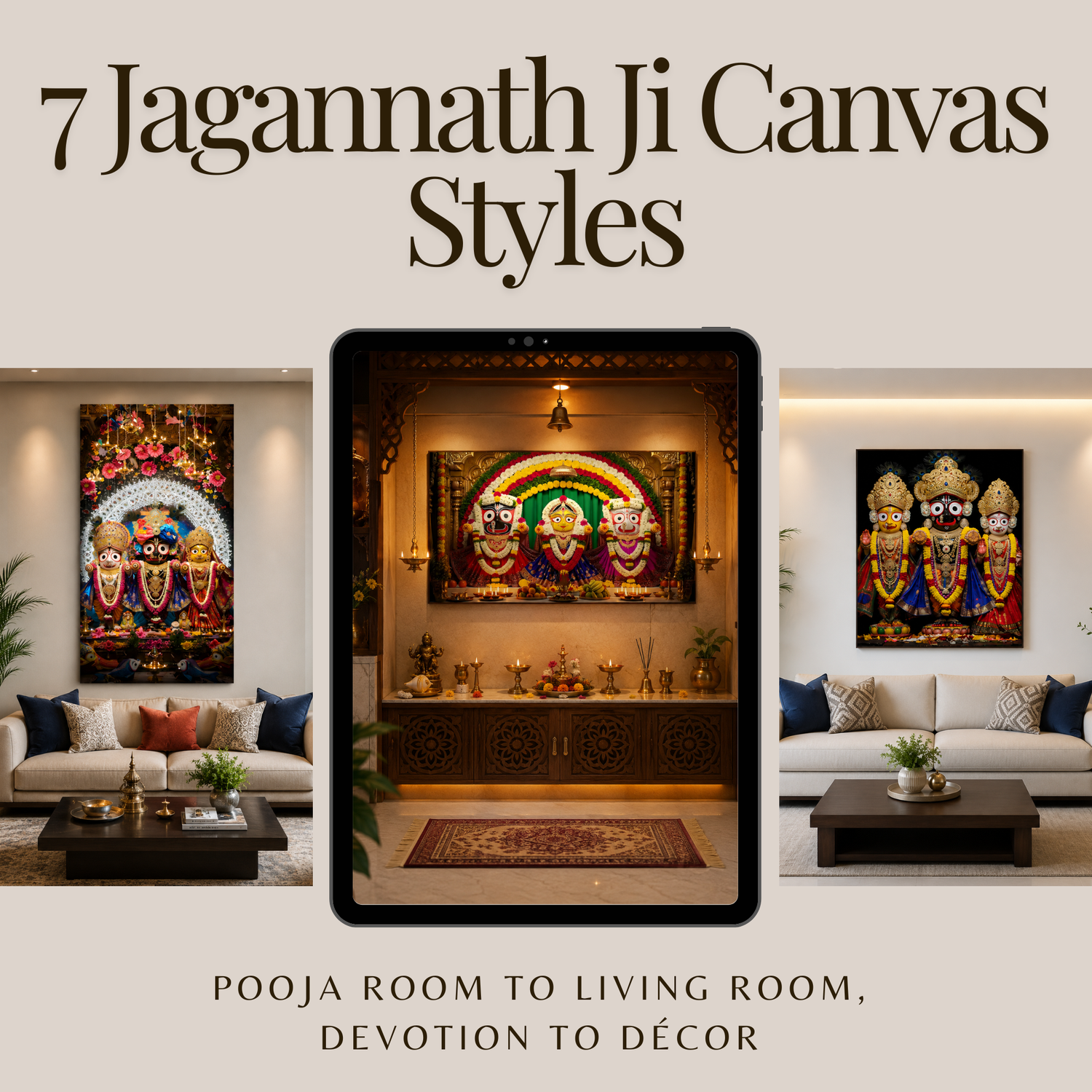
You already know you want a Jagannath painting on canvas. That decision was made somewhere between a moment of devotion and the quiet realization that your wall deserves more than just colour - it deserves meaning. The real question now is which one.
Lord Jagannath is not a deity who comes in one mood. He is the Lord of the Universe - festive and fierce, tender and cosmic, deeply rooted in Odisha's temple culture yet strangely at home in a modern Mumbai apartment or a Bengaluru living room with pendant lights and a linen sofa. The style of canvas painting you choose will shape not just how your wall looks, but how your space feels.
This guide breaks down seven distinct styles of Jagannath canvas art - what each one looks like, where it belongs in your home, the vibe it creates, and the spiritual intent it carries. Read through, trust your instinct, and you'll know exactly which one is yours.
1. The Temple Altar Style - For Spaces That Want to Feel Like a Sanctum
The Visual
This style draws directly from the grandeur of the Puri Jagannath temple. Think richly adorned figures of Jagannath, Balabhadra, and Subhadra positioned as they would appear on a sanctum altar - garlands of marigold, the warm flicker of diyas, gold halos, and deep jewel-toned backgrounds that feel both ancient and alive.
Best Room
Pooja room, home temple, or any dedicated prayer corner. This is the style that was made for sacred spaces. If you have a mandir setup - even a simple one - this canvas becomes its most powerful backdrop.
The Vibe
Devotional. Grounded. Ceremonial. Walking past this painting feels like walking past something that has already been prayed over for a thousand years.
Spiritual Intent
Altar-style Jagannath art is rooted in darshan - the sacred act of seeing and being seen by the divine. In Hindu tradition, the eyes of Jagannath are considered especially powerful, wide and unwavering, offering protection and blessings to all who stand before them. Placing this in your pooja room is less about decoration and more about establishing a divine gaze in your home.
If your pooja room has felt incomplete despite all the effort you've put into it, it may simply be waiting for the right focal point.
2. The Sacred Trinity Style - For Homes That Honour the Whole Story
The Visual
Jagannath is rarely alone. His brother Balabhadra and sister Subhadra stand beside him - three figures, three energies, one divine family. Trinity-style canvas paintings present all three together, often in vibrant traditional attire against dramatic backgrounds. The colour palette tends to be bold - saffron, white, yellow, black - each colour carrying its own symbolic weight.
Best Room
Living room, entryway, or a prominent wall where guests will naturally pause. The trinity composition has a natural completeness to it - it fills a wall the way a family portrait does, with warmth and presence.
The Vibe
Celebratory. Familial. Spiritually whole. There is something about seeing all three siblings together that feels like harmony made visible.
Spiritual Intent
In Vaishnava philosophy, the trinity of Jagannath, Balabhadra, and Subhadra represents the union of the divine masculine, divine feminine, and the sacred bond of siblinghood. Welcoming all three into your home is believed to bring balance, protection, and a sense of divine completeness. Many devotees choose the trinity specifically because it feels like the whole family is home.
3. The Festival and Rath Yatra Style - For Walls That Should Radiate Joy
The Visual
Rath Yatra is one of the largest religious gatherings in the world, and paintings inspired by it carry that energy. Expect floral decorations, hanging diyas, temple architecture, festive colour arrangements, and a sense of movement - as though the celebration is still in progress. These canvases are visually generous, layered with detail that rewards a second and third look.
Best Room
Living room, dining area, or any social space where energy and conversation gather. This style thrives in rooms that see life - not quiet corners.
The Vibe
Joyful. Vibrant. Communal. There is an extroversion to Rath Yatra art that makes even a quiet Tuesday feel like the eve of something significant.
Spiritual Intent
The Rath Yatra represents Lord Jagannath leaving his temple to meet his devotees - a rare and profound reversal where the divine comes to the people, not the other way around. A painting in this style carries that same energy of grace coming outward, of blessing extended beyond the sanctum and into everyday life. It is a particularly auspicious choice for a home that values generosity and open doors.
4. The Portrait Devotional Style - For Intimate, Emotionally Charged Spaces
The Visual
A single, vertical portrait of Lord Jagannath - close, detailed, and emotionally present. These paintings focus on the deity's face and adornments: pearl necklaces, peacock feathers, marigold malas, a glowing golden or red halo. The composition is intimate rather than panoramic. You feel like you are with him, not observing him from a distance.
Best Room
Bedroom, meditation corner, personal altar, or any quiet space that belongs to you alone. This style is deeply personal - it is not for showing off; it is for returning to.
The Vibe
Still. Warm. Quietly powerful. The kind of image you look at before you sleep and when you wake up.
Spiritual Intent
Portrait-style Jagannath art is an invitation to personal devotion - bhakti in its most private form. The large, expressive eyes of the Lord are said to see into the heart of the devotee, holding space for prayer, grief, gratitude, and everything in between. If you have a spiritual practice - meditation, morning prayer, journaling - this style of canvas becomes a silent witness to it.
There is a difference between art that decorates a room and art that holds it. Portrait Jagannath art holds the room.
5. The Golden Halo and Festive Radiance Style - For Modern Homes That Don't Want to Choose Between Faith and Aesthetics
The Visual
This style sits at the intersection of devotional art and contemporary interior design. Lord Jagannath is depicted in rich saffron or red attire, often with a luminous golden halo, marigold garlands, and a warm, glowing background that feels almost painterly in its light. The result is something that looks deeply spiritual but also - and this matters - genuinely beautiful as a piece of visual art.
Best Room
Living room, pooja room, or any space where you want spiritual presence without visual heaviness. This style pairs exceptionally well with warm neutrals, wooden furniture, brass accents, and ambient lighting.
The Vibe
Radiant. Elevated. Devotional without being dense. The kind of art that earns compliments from guests who may not share your faith but can still feel the warmth it carries.
Spiritual Intent
The golden halo in Hindu iconography represents prabhamandala - the aura of divine light that surrounds an enlightened being. Choosing this style is an acknowledgment that divinity is not separate from beauty, that the sacred and the aesthetic are not in tension. For homes that navigate both modernity and tradition, this canvas is the one that makes both feel honoured.
6. The Sunset Temple Style - For Spaces That Carry a Contemplative Energy
The Visual
Imagine Lord Jagannath rendered against the warm amber and deep crimson of a temple at dusk - a glowing red halo, diya lights scattered like fallen stars, floral petals at rest. There is a twilight quality to these paintings, a sense of the day releasing itself into something quieter and more profound.
Best Room
Bedroom, study, meditation room, or a reading nook. Any space where you wind down, reflect, or seek stillness.
The Vibe
Contemplative. Soft. Deeply calming. This is the style for people who treat their home as a retreat.
Spiritual Intent
Sandhya - the twilight hour - holds special significance in Hindu practice. It is the time of the evening prayer, when the day dissolves and the mind naturally turns inward. A sunset temple canvas carries this energy into the room permanently, making the space feel like a place where reflection is always welcome. It is particularly well-suited to bedrooms, where the last thing you see before sleep shapes the quality of your rest.
7. The Cosmic Vishwaroop Style - For Spaces That Think Big
The Visual
This is Jagannath at his most expansive. The Vishwaroop - the universal form - depicts the Lord against a celestial backdrop: deep cosmic blues and blacks, a galaxy halo, planetary rings, and a sacred aura that stretches beyond the edges of the canvas. It is the most visually ambitious style in the collection, and the one that makes the biggest statement.
Best Room
Living room feature wall, home office, or any large wall that can hold a statement piece. This style demands space - and rewards it.
The Vibe
Expansive. Awe-inspiring. Philosophically weighty. The kind of painting that makes the room feel larger than it is.
Spiritual Intent
The Vishwaroop is the form in which the divine reveals itself as everything - boundless, containing multitudes, beyond human categorisation. In the Bhagavad Gita, Krishna reveals this form to Arjuna as the ultimate truth of existence. A Vishwaroop Jagannath canvas is not just decor - it is a daily reminder that the space you inhabit is part of something infinitely larger. For home offices, study rooms, or creative spaces, this is a particularly potent choice.
Some art asks to be looked at. This one asks to be sat with.
How to Choose the Right Style for Your Home
If you are still deciding, here is a simple way to think about it:
- Pooja room or home temple → Temple Altar or Portrait Devotional
- Living room or entryway → Sacred Trinity, Rath Yatra Festival, or Golden Halo Radiance
- Bedroom or meditation space → Portrait Devotional or Sunset Temple
- Home office or study → Cosmic Vishwaroop
- Modern home, wants art that bridges faith and aesthetics → Golden Halo Radiance or Sunset Temple
- Traditional home, wants full devotional energy → Temple Altar or Sacred Trinity
One more thing worth knowing: the frame choice matters more than most people realise. A black floater frame adds contemporary structure and makes the painting feel curated - ideal for modern or eclectic interiors. Canvas-wrapped edges give the artwork an organic, gallery-like finish that works beautifully in warmer, more traditional spaces. Both are available across the collection.
Explore the Jagannath Canvas Collection at Cipher Spaces
All seven styles described in this guide are part of the Jagannath Ji canvas wall art collection at Cipher Spaces - each piece available in multiple sizes, starting from ₹2,499. Whether you are looking for a quiet portrait for your bedroom or a large-format cosmic statement for your living room, the collection has been curated with both devotion and design intent in mind.
Every canvas is printed on premium material and arrives ready to hang - no extra framing, no guesswork. Just the art, the wall, and the presence it brings.
Explore Other Collections from Cipher Spaces
If Jagannath Ji canvas art speaks to your love of devotional and spiritual interiors, you might find these collections equally resonant:
- Radha Krishna Wall Art - for spaces that carry the energy of divine love and union
- Pichwai Wall Art - the intricate devotional art tradition of Nathdwara, now on canvas
- Shrinath Ji Wall Art - warm, Pushti Marg-inspired devotional art for traditional homes
- Hanuman Ji Wall Art - strength, protection, and devotion rendered in bold, striking imagery
- Vastu and Divinity Wall Art - art chosen for its spiritual energy and Vastu alignment
- Buddha Wall Art - for spaces that seek stillness, clarity, and meditative calm