
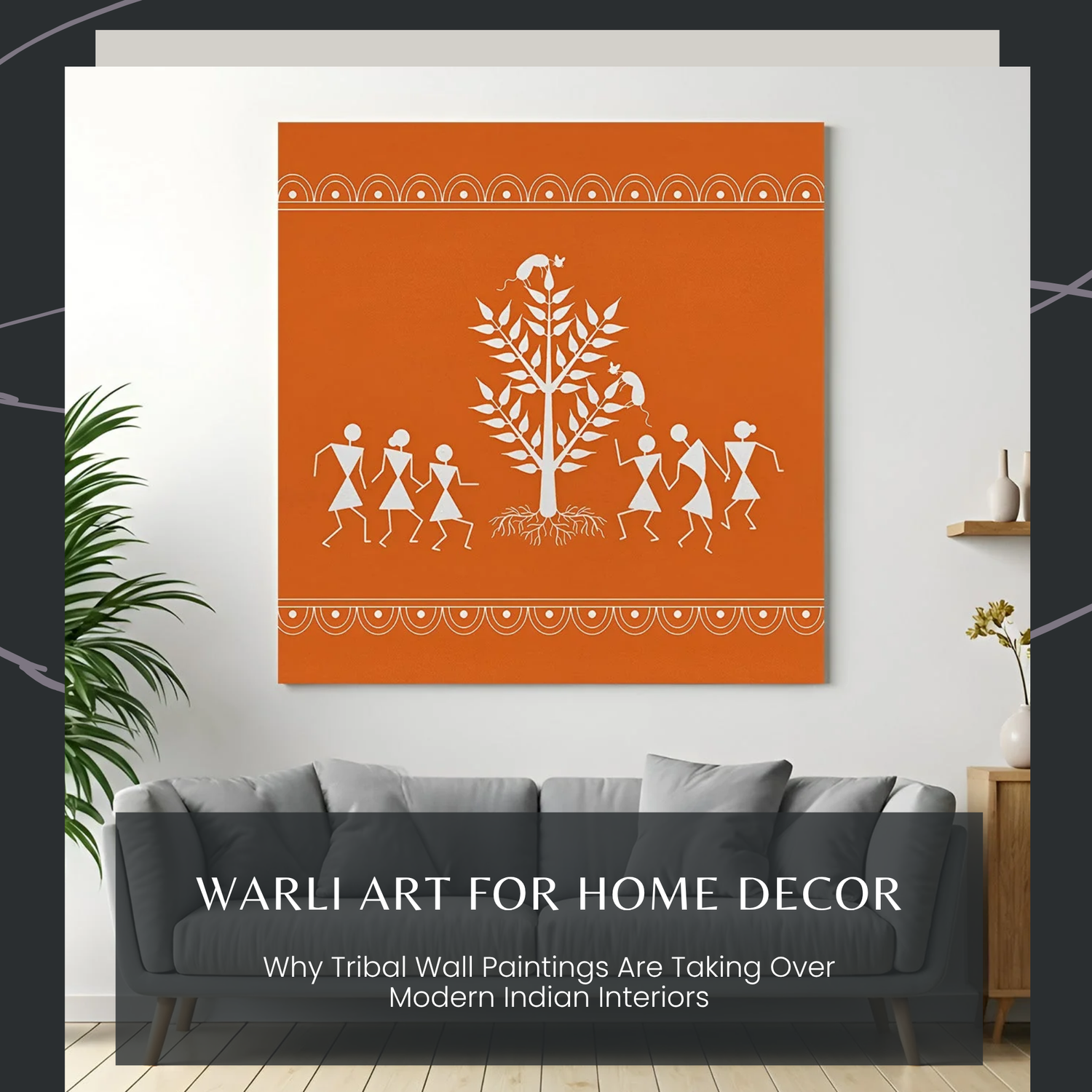
There is a quiet revolution happening on Indian walls. As homeowners move away from mass-produced prints and generic abstracts, a more rooted aesthetic is taking their place - and Warli tribal art sits squarely at the centre of this shift. With their stark white figures on earthy backgrounds, geometric rhythms, and timeless narratives of village life, Warli canvas paintings offer exactly what modern interiors increasingly crave: depth without clutter, story without noise.
This guide walks you through everything you need to know - the origins of the art form, how it fits into contemporary homes, which sizes and frames work in which rooms, and how to shop for the right piece. If you have been searching for wall decor that feels both culturally rooted and visually contemporary, read on.
What Is Warli Art? A Brief Cultural Background
Warli art originates from the Warli tribe of Maharashtra's Palghar district, one of India's largest tribal communities. Practised for centuries - with roots potentially stretching back to 2500–3000 BCE - Warli painting was traditionally created by women on the mud walls of huts, using rice paste as the primary pigment. The result was luminous white figures on a warm, terracotta-brown ground.
What makes Warli so enduring is its visual grammar. The art form relies on just three geometric shapes - the circle, triangle, and square - to construct an entire world: dancing figures (the tarpa dance), farming scenes, wedding processions, animals, trees, and the rhythms of seasonal life. Every motif carries meaning. Every line is intentional.
When Warli was first introduced to urban audiences in the 1970s through the work of artist Jivya Soma Mashe, it entered the mainstream art world. Today, Warli painting on canvas bridges that tribal tradition with contemporary interior design - making the art form accessible to homes, offices, and creative spaces across India.
Why Warli Works in a Modern, Minimalist Interior
Minimalism as a design philosophy champions negative space, restrained palettes, and purposeful objects. Warli art - almost paradoxically - achieves the same effect through tribal complexity. Here is why the two align so naturally:
A Naturally Earthy Colour Palette
Traditional Warli art uses a warm brown base with white figures - a palette that pairs effortlessly with neutral walls, wooden furniture, linen furnishings, and terracotta accents. Unlike brightly coloured folk arts, Warli never competes with existing decor. It complements it.
Geometric Forms That Read as Contemporary
The triangles, circles, and repeated line patterns in Warli compositions echo the geometric abstraction found in Scandinavian and Japanese design. To the untrained eye, a Warli panel reads as sophisticated modern art. To those who know the language, it is a rich, layered narrative - two readings coexisting in the same frame.
Human-Scale Storytelling
Unlike grand mythological paintings, Warli depicts the everyday: people harvesting, celebrating, cooking, dancing. This intimacy makes Warli wall art feel warm and approachable rather than imposing - a quality particularly valued in living rooms, bedrooms, and home offices where art is seen daily.
Cultural Authenticity in an Age of Mass Production
In a world of identical prints, Warli wall paintings carry genuine cultural provenance. Displaying Warli art in your home is a quiet statement - one that values craft, story, and heritage over trend-driven decoration.
Room-by-Room Ideas: Where to Place Warli Wall Art
Living Room
The living room is where Warli truly shines. Anchor the space with a large canvas above your sofa - a 48×48 inch or 30×60 inch format fills the wall without crowding the space. Pair it with warm-toned cushions in terracotta, ochre, or cream. For a bolder approach, group three smaller Warli pieces in matching black floater frames in a horizontal triptych arrangement.
Bedroom
Warli's village scenes and nature motifs bring a grounding, meditative quality to bedrooms. A tall 24×48 inch portrait canvas flanking either side of the bed creates visual balance, or hang a single large canvas above the headboard as a cultural alternative to generic headboard art. Pair with linen bedding and natural wood furniture for a cohesive look. Browse our bedroom wall art collection for more ideas.
Home Office and Study Room
A study room benefits enormously from art that is visually engaging but not distracting. Warli's rhythmic patterns and muted palette create an atmosphere that fosters focus and creativity. A 36×36 inch piece with a golden floater frame adds a sense of cultural authority to a home office - ideal for professionals, designers, and educators. See our full office wall art collection for curated picks.
Entryway and Hallway
A 30×60 inch Warli panel in a hallway immediately communicates cultural taste and artistic sensibility. Since hallways are typically viewed from close range, the intricate detail of Warli compositions rewards careful looking - something guests will notice the moment they walk in.
Choosing the Right Size and Frame: A Simple Guide
| Room / Wall | Recommended Size | Frame Style | Why It Works |
|---|---|---|---|
| Large living room sofa wall | 48×48" or 30×60" | Canvas Wrapped or Golden Frame | Fills the wall without crowding the space |
| Bedroom accent wall | 24×48" or 24×24" | Black Floater Frame | Creates drama without overwhelming the room |
| Home office or study | 36×36" or 24×24" | Golden or Black Floater | Adds inspiration without distraction |
| Hallway or entryway | 18×24" or 30×60" | Canvas Wrapped | Makes a strong first impression in a narrow space |
| Gallery wall component | 18×24" or 24×24" | Black Floater Frame | Consistent framing unifies the arrangement |
Frame tip: Black floater frames suit modern and minimalist interiors and contrast cleanly against white walls. Golden floater frames add warmth and richness, making them ideal for traditional Indian interiors or rooms with warm-toned wooden furniture and accent lighting.
Sizing tip: Art above a sofa should be roughly 60–75% of the sofa's width, and hung so its centre sits at approximately 145–155 cm from the floor - average standing eye level.
Warli vs. Other Indian Folk Art Styles: Which Is Right for Your Space?
Warli is one of several celebrated Indian folk art traditions now available on canvas. Here is how it compares to popular alternatives:
| Art Style | Visual Character | Colour Palette | Best For |
|---|---|---|---|
| Warli | Geometric figures, tribal narratives | Earthy brown and white | Minimalist, boho, modern Indian interiors |
| Kalamkari | Intricate pen-drawn figures, mythology | Indigo, red, black, natural dyes | Traditional and detailed interiors |
| Madhubani | Dense floral patterns, folk motifs | Vivid, multi-colour | Colourful, eclectic, festive spaces |
| Pichwai | Devotional Krishna scenes, lotus flowers | Rich jewel tones with gold | Spiritual, luxurious, traditional interiors |
| Tanjore | Embossed gold, divine figures | Gold and jewel colours | Heritage, devotional, grand interiors |
Choose Warli if your interior leans neutral and modern, if you prefer understated cultural expression, or if you want art that works equally well in a home and a professional environment. Its restraint is its greatest strength.
Pricing Overview for Warli Canvas Wall Art
| Artwork | Size | Frame Style | Sale Price |
|---|---|---|---|
| Warli Canvas Art – Wall Painting for Modern Indian Interiors | 18×24 inches | Canvas Wrapped | From Rs. 2,499 |
| Warli Canvas Wall Art – Tribal Indian Painting for Minimalist Home Decor | 24×48 inches | Black Floater Frame | From Rs. 2,499 |
| Warli Large Canvas Wall Painting – Tribal Indian Art for Home Decor | 48×48 inches | Canvas Wrapped | From Rs. 3,499 |
| Warli Tribal Painting on Canvas – West Indian Folk Wall Art from Maharashtra | 30×60 inches | Golden Floater Frame | From Rs. 2,499 |
| Warli Tribal Art Canvas Painting – Authentic Indian Folk Wall Decor | 36×36 inches | Golden Floater Frame | From Rs. 3,499 |
| Warli Canvas Wall Art – Tribal Painting for Ethnic Home and Office Decor | 24×24 inches | Black Floater Frame | From Rs. 3,499 |
View the full range and current availability on the Warli wall art collection page.
Frequently Asked Questions
Is Warli painting on canvas authentic to the original art form?
Canvas adaptations maintain the visual language of Warli - the white-on-brown motifs, geometric forms, and narrative scenes - while adapting the traditional mud-wall medium to a format suitable for modern homes. The artistic vocabulary is authentic even as the material evolves.
What colours and furniture styles pair well with Warli wall art?
Warli's earthy palette pairs best with neutral walls (white, ivory, warm grey, beige), natural materials (cane, rattan, jute, wood), and earthy accent colours (terracotta, ochre, sage, rust). It also works beautifully in boho-inspired and Japandi-influenced interiors.
Can Warli art work in an office or professional space?
Yes. Warli's restrained palette and geometric compositions make it one of the most office-appropriate folk art styles. It communicates cultural sophistication without being overtly decorative. See our office wall art collection for curated picks.
What are good alternatives to Warli wall art?
If you love Indian folk art but want a different mood, consider Madhubani wall art for vibrant colour, Pichwai paintings for devotional depth, or Kalamkari art for intricate pen-drawn narratives. All styles start from Rs. 2,499 at CipherSpaces.
What is the difference between a black floater frame and a golden floater frame?
Black floater frames are the more contemporary choice - they suit modern and minimalist interiors and contrast cleanly with white or grey walls. Golden floater frames add warmth and richness, making them ideal for traditional Indian interiors, wooden furniture settings, or spaces with warm accent lighting.
Ready to bring Warli art into your home? Browse the full Warli canvas wall art collection at CipherSpaces - eight curated pieces across multiple sizes, formats, and frame styles, each one a celebration of one of India's oldest artistic traditions.