
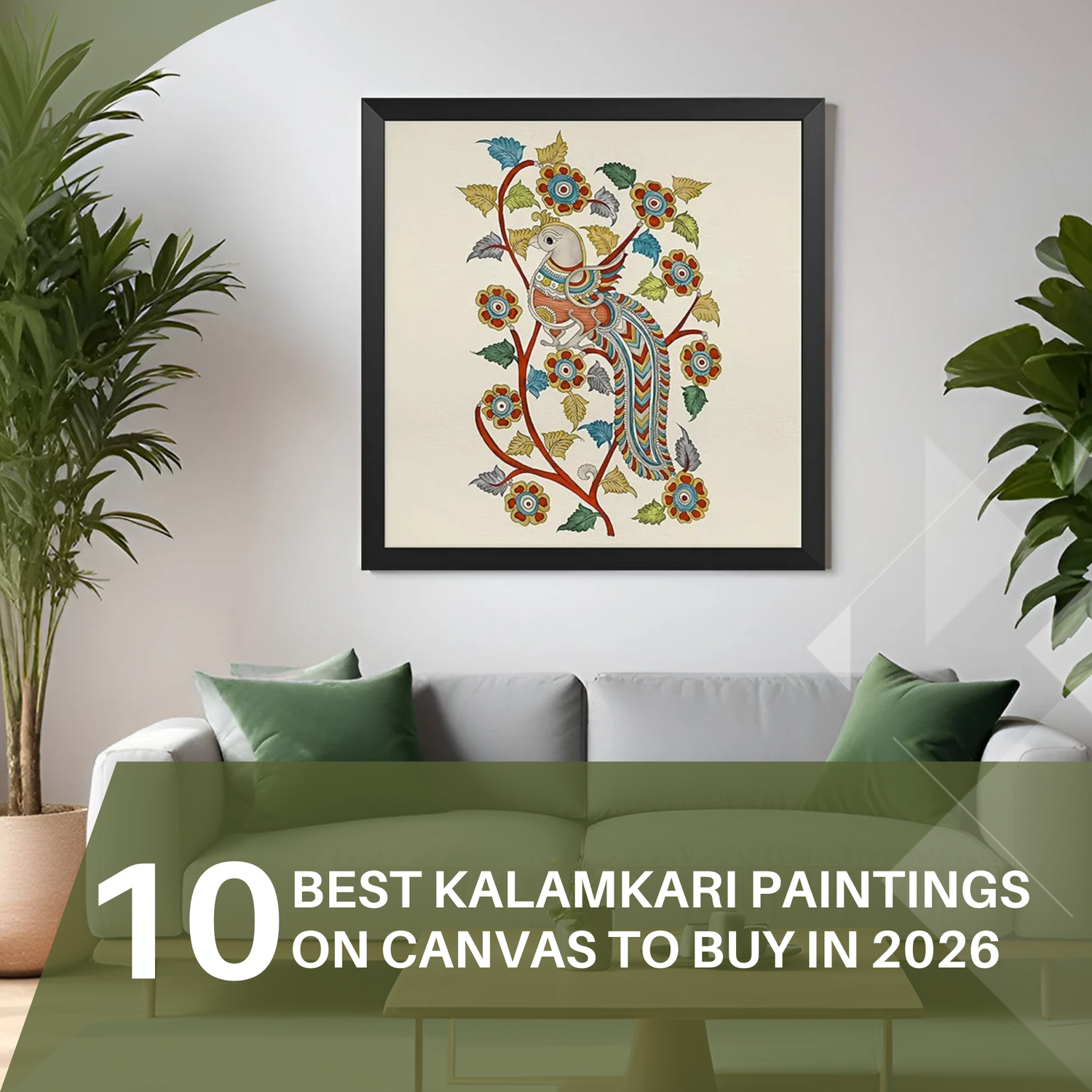
Kalamkari painting on canvas has quietly become one of the most searched Indian art forms online - and for good reason. Whether you are decorating a living room, gifting a collector, or building an investment-grade art collection, kalamkari on canvas offers a rare combination of ancient technique, vivid natural storytelling, and genuine artisanal value.
But the market is noisy. Scroll through any marketplace and you will find everything from ₹299 machine-printed fakes to ₹25,000 museum-quality hand-drawn originals - all labelled "kalamkari." This guide cuts through the confusion.
We reviewed the 10 best kalamkari paintings available on canvas across styles, price bands, and sourcing options - with honest notes on authenticity, size, and value for money. If you also want to understand the vastu and symbolic significance of kalamkari in your home, read our detailed guide on kalamkari wall art symbolism and vastu benefits.
Table of Contents
- What Is Kalamkari Painting on Canvas?
- The Two Great Styles: Srikalahasti vs. Machilipatnam
- The 10 Best Kalamkari Paintings on Canvas
- Quick Comparison Table
- 5 Things to Check Before You Buy
- Hand-Painted vs. Canvas Print: Which Is Right for You?
- Caring for Your Canvas Kalamkari
- Frequently Asked Questions
- Final Verdict
What Is Kalamkari Painting on Canvas?
The word kalamkari comes from the Persian words kalam (pen) and kari (work). Traditionally practiced on cotton or silk fabric using natural dyes, kalamkari is a 3,000-year-old Indian art form rooted in the temple towns of Andhra Pradesh.
In recent decades, artists have adapted the same hand-drawing and natural dyeing techniques onto stretched canvas, making kalamkari paintings more accessible for modern interiors - easier to frame, hang, and preserve than fabric pieces, while retaining all the visual richness of the original craft.
Authentic kalamkari on canvas uses a bamboo or palm pen dipped in fermented jaggery and iron solution to draw bold black outlines, then fills them with natural dyes sourced from pomegranate rinds, indigo, turmeric, and more. The process involves multiple boiling, drying, and dyeing stages - a single piece can take anywhere from three days to three months.
The Two Great Styles: Srikalahasti vs. Machilipatnam
Before choosing a kalamkari painting on canvas, you need to understand the fundamental split between the two major traditions.
Srikalahasti Style - Freehand & Narrative
Originating in the Srikalahasti temple town of Andhra Pradesh, this style is entirely hand-drawn with the kalam pen. No stencils, no blocks, no guides. Themes are almost exclusively drawn from Hindu mythology - scenes from the Ramayana, Mahabharata, the exploits of Shiva, Vishnu, or Devi. Lines are confident and fluid; the faces of gods and goddesses have a stylised, almost archaic beauty. This is the collector's choice and commands a higher price.
Machilipatnam Style - Block Print & Floral
From the coastal town of Machilipatnam (also called Masulipatnam), this style combines carved wooden block printing with hand-painted detailing. Patterns tend to be more geometric and floral - Persian-influenced paisleys, vines, and motifs that reflect the region's historical textile trade with the Middle East. Machilipatnam kalamkari on canvas is generally more affordable, more symmetrical in design, and works beautifully as décor even for buyers unfamiliar with Indian iconography.
Buyer note: Many sellers use "kalamkari" as an umbrella term without specifying the style. Always ask: Is this Srikalahasti or Machilipatnam? Freehand or block print? The answer directly affects both the price and the piece's collectible value.
The 10 Best Kalamkari Paintings on Canvas (Ranked)
The following picks span both traditions, multiple price points, and a range of themes - from grand mythological narratives to compact gifting pieces. Each has been evaluated on authenticity, artistic quality, canvas and dye quality, and real-world value for money.
1. Dashavatara - Ten Avatars of Vishnu (Srikalahasti, Large Format)
Style: Srikalahasti · Freehand | Price range: ₹8,000 – ₹30,000 | Best for: Collectors, statement walls
The crown jewel of any kalamkari collection. A large-format Dashavatara composition depicts all ten incarnations of Lord Vishnu - from the fish Matsya to Kalki - arranged in a grand narrative frieze. On canvas, this piece commands a wall. The best examples from Srikalahasti master artists feature extraordinarily fine pen work in the facial expressions and weapon details, with rich natural reds and indigos that deepen with age rather than fading.
Look for pieces sourced directly from GI-certified artisan cooperatives or government-run Lepakshi emporiums to ensure authenticity. A well-executed Dashavatara on a 30×48 inch canvas is an investment piece that appreciates over time.
Verdict: Best overall pick - Highest artistic merit, genuine investment value, and the most recognisably "kalamkari" of all formats.
2. Ardhanarishvara - The Half-Male, Half-Female Shiva (Srikalahasti)
Style: Srikalahasti · Freehand | Price range: ₹4,500 – ₹18,000 | Best for: Living rooms, meditation spaces
The Ardhanarishvara composition - depicting Shiva and Parvati merged into one divine form - is among the most philosophically rich and visually striking subjects in Indian art. On canvas in the Srikalahasti tradition, this subject allows gifted artists to demonstrate extraordinary skill: two distinct visual vocabularies (masculine, feminine) united in one body, typically set against a floral and celestial background.
This is the best single-figure kalamkari painting for someone wanting a centrepiece that is both devotional and intellectually compelling. Medium formats (18×24 inch) are widely available from artisan clusters; larger commissions (24×36 and above) should be ordered directly from named artists.
Verdict: Best single-figure mythology pick - Rare subject handled with exceptional finesse by top Srikalahasti artists.
3. Radha-Krishna Raas Leela (Srikalahasti, Square Format)
Style: Srikalahasti · Freehand | Price range: ₹3,500 – ₹14,000 | Best for: Gifting, pooja rooms, bedrooms
The eternal love story of Radha and Krishna is the most commercially popular subject in Indian religious art. But the Srikalahasti freehand version on canvas occupies a different category from the printed versions that flood online marketplaces. A hand-drawn Raas Leela on canvas captures movement, rhythm, and devotional energy in a way that block prints simply cannot.
The square format (24×24 inch) works particularly well for this subject, with the circular dance arrangement fitting naturally within the frame. Pieces from the Chittoor district of Andhra Pradesh are especially well-regarded for this theme.
Verdict: Best for gifting - Universally appreciated subject, widely available in mid-range pricing, appropriate for almost any occasion.
4. Machilipatnam Peacock & Floral Vine Panel (Block Print + Hand Finish)
Style: Machilipatnam · Block Print | Price range: ₹2,500 – ₹9,000 | Best for: Modern interiors, hallways
The peacock has always been the signature motif of Machilipatnam kalamkari, and when rendered as a large panel on canvas with interlocking floral vines, it becomes one of the most versatile Indian art pieces for contemporary homes. Unlike mythological Srikalahasti works, this piece requires no prior knowledge of iconography to appreciate - its beauty is immediately visual and decorative.
The best examples feature a base block print for the vines and peacock body, with hand-painted indigo and rust fills and fine hand-drawn detailing on the feathers and flowers. Avoid pieces where the block printing is visible as mechanical repetition without any hand-finishing. For guidance on placement and vastu direction, see our guide on peacock wall art vastu benefits and placement.
Verdict: Best for contemporary interiors - Works in both traditional and modern décor contexts; most approachable entry point for first-time buyers.
5. Ramayana Story Scroll - Horizontal Narrative Canvas
Style: Srikalahasti · Freehand | Price range: ₹6,000 – ₹45,000 | Best for: Dedicated display walls, institutions
If you want to own kalamkari as a narrative experience, the horizontal story scroll is the format for you. A full Ramayana scroll on canvas - from Rama's birth in Ayodhya to Lanka's burning - can run 6 to 10 feet in length and 18 inches in height, telling the entire epic in sequential panels separated by floral borders, much like an ancient manuscript brought to life.
These are best purchased as custom commissions from Srikalahasti artisan groups or through craft NGOs that work directly with the artists. Ready-made shorter versions (2–4 feet) are available in craft stores and provide a good taste of the scroll format at a lower price point.
Verdict: Best for serious collectors - No other format communicates the storytelling depth of kalamkari as powerfully as the narrative scroll.
6. Ganesha on Natural Cream Canvas (Small Format)
Style: Srikalahasti · Freehand | Price range: ₹800 – ₹4,000 | Best for: Gifting, offices, study rooms
The most gifted item in the kalamkari world. A hand-drawn Ganesha on a small natural canvas (12×16 or 16×20 inch) sits at the sweet spot of price, sentiment, and artistic merit. The cream unbleached canvas - used in better pieces rather than stark white - gives the natural dyes an earthy warmth that looks authentically aged from day one.
Look for compositions where the artist has used the cream canvas tone as a third "colour" in the design, allowing the rust and indigo to sing against it without filling every inch. Sparse compositions are typically better quality than over-packed ones - they signal a confident artist.
Verdict: Best budget authentic pick - Highest artisan value per rupee in this entire guide; hard to go wrong.
7. Machilipatnam Tree of Life - Persian-Inspired Canvas
Style: Machilipatnam · Block Print | Price range: ₹2,000 – ₹8,500 | Best for: Cross-cultural interiors, offices
The Tree of Life motif arrived in Machilipatnam through centuries of Persian textile trade and has since become one of the most distinctive kalamkari patterns anywhere. On canvas, a well-executed Tree of Life composition typically features a central flowering tree with deer, birds, and flowers radiating outward in a symmetrical pattern - calming, universal, and almost secular in its appeal.
This is one of the few kalamkari subjects that works equally well in South Asian homes and Western interiors. The earth tones of natural dye versions - terracotta, indigo, ochre on cream - appeal to the same aesthetic sensibility as ethnic Moroccan or Southwestern American décor.
Verdict: Best for non-Indian décor contexts - Universal enough to work anywhere; one of kalamkari's most exportable subjects.
8. Devi Mahatmya - Durga Mahishasura Mardini (Large Format)
Style: Srikalahasti · Freehand | Price range: ₹7,000 – ₹28,000 | Best for: Devotional display, collectors
Durga slaying the buffalo demon Mahishasura is one of Indian art's most powerful compositional challenges - ten arms, each wielding a divine weapon, a lion mount, a vanquished demon, all held in dynamic tension within a single frame. In the hands of a master Srikalahasti artist on a large canvas (30×40 inch or above), this is among the most visually dramatic kalamkari paintings you can own.
This subject also has strong auspicious associations - many buyers commission a Durga Mahishasura Mardini specifically for Navratri display, and the canvas format stores and travels better than the traditional cloth alternatives.
Verdict: Best devotional piece - Maximum visual impact; sought-after for both artistic and religious reasons.
9. Contemporary Kalamkari - Abstract & Wildlife Fusion Canvas
Style: Contemporary · Fusion | Price range: ₹3,000 – ₹20,000 | Best for: Urban homes, secular gifting
A younger generation of kalamkari artists - many trained in traditional techniques but educated in modern design - has begun applying the kalam pen and natural dyes to non-mythological subjects: tigers, elephants, migratory birds, and abstract geometric compositions that retain the visual language of kalamkari while shedding its religious iconography.
These contemporary kalamkari canvases are increasingly popular with urban buyers who appreciate the craft but want something more secular for their home. The best examples are coming from art incubators in Hyderabad and from individual artists active on Instagram. Price validation is harder in this segment - buy from artists who share their process. If you enjoy non-traditional Indian art styles, also browse our abstract wall art collection.
Verdict: Best for secular modern spaces - Full kalamkari technique, zero religious iconography; ideal for buyers wanting craft over devotion.
10. Machilipatnam Paisley Triptych - Three-Panel Canvas Set
Style: Machilipatnam · Block Print | Price range: ₹3,500 – ₹12,000 (set) | Best for: Large walls, gifting sets
For buyers who want to fill a large wall without the cost of a single large canvas, a three-panel Machilipatnam triptych offers an elegant solution. Each panel carries the same floral or paisley motif in slightly different arrangements, creating a unified composition when displayed together. The set format also makes this the most giftable large-format option - the pieces can be shipped flat and reassembled on the wall.
Best versions use a consistent natural dye palette across all three panels, with careful colour-matching between pieces. Beware of sets where panels are independently produced without colour coordination - they look disjointed on the wall.
Verdict: Best wall-filling solution - The smartest format for buyers with large wall space and mid-range budgets.
Quick Comparison Table
| # | Painting | Style | Price Range | Best For |
|---|---|---|---|---|
| 1 | Dashavatara - Ten Avatars | Srikalahasti | ₹8,000 – ₹30,000 | Collectors |
| 2 | Ardhanarishvara | Srikalahasti | ₹4,500 – ₹18,000 | Statement piece |
| 3 | Radha-Krishna Raas Leela | Srikalahasti | ₹3,500 – ₹14,000 | Gifting |
| 4 | Peacock & Floral Vine | Machilipatnam | ₹2,500 – ₹9,000 | Modern interiors |
| 5 | Ramayana Story Scroll | Srikalahasti | ₹6,000 – ₹45,000 | Serious collectors |
| 6 | Ganesha Small Format | Srikalahasti | ₹800 – ₹4,000 | Budget gifting |
| 7 | Tree of Life | Machilipatnam | ₹2,000 – ₹8,500 | Cross-cultural décor |
| 8 | Durga Mahishasura Mardini | Srikalahasti | ₹7,000 – ₹28,000 | Devotional display |
| 9 | Contemporary Wildlife Fusion | Contemporary | ₹3,000 – ₹20,000 | Secular modern homes |
| 10 | Paisley Triptych (3-panel set) | Machilipatnam | ₹3,500 – ₹12,000 | Large walls |
5 Things to Check Before You Buy a Kalamkari Painting on Canvas
1. Ask about the dye source - natural or chemical?
Authentic kalamkari uses natural dyes derived from plants and minerals: pomegranate rinds for black, indigo for blue, turmeric for yellow, madder root for red. Chemical dyes are brighter but fade faster and lack the warm complexity of natural tones. Natural dye pieces also have a distinctive earthy smell when new that disappears after airing. If a seller cannot tell you the dye source, that is a red flag.
2. Check the canvas material and preparation
Traditional kalamkari canvas is treated with a natural myrobalan (haritaki) solution before painting, which helps the natural dyes bond to the surface. Properly prepared canvas has a slightly off-white, warm cream tone - not stark white. Machine-treated or untreated canvas will look either too white or too uniform. Stretch canvas on a wooden frame is preferable to rolled canvas for long-term structural integrity.
3. Understand what format you are actually buying
Kalamkari on canvas comes in three distinct formats, each with its own price point and purpose. Hand-painted originals are made entirely with the kalam pen and natural dyes - labour-intensive, one-of-a-kind, and priced accordingly. Hand-painted reproductions recreate traditional compositions with skilled brushwork and are a more accessible option without sacrificing the handmade quality. High-quality canvas prints - such as those using archival eco-solvent or pigment inks - faithfully reproduce the kalamkari artwork on canvas and are a perfectly legitimate, affordable way to bring this art form into your home. The key is that a good seller will always be transparent about which format you are buying. If a listing is vague, ask.
4. Verify the size against your wall before ordering
Kalamkari is a scale-dependent art form. A Dashavatara composition on a 12×16 canvas looks cramped and loses detail; the same composition on a 30×48 canvas becomes transformative. Always measure your wall, decide on framed or unframed dimensions, and then order size. Most artisan sellers take custom size commissions with 3–6 week lead times. Not sure which wall to hang it on? Our guides on best paintings for the north wall and vastu paintings for the south wall will help you decide.
5. Buy from sellers who are upfront about what they are selling
The real risk in the kalamkari market is not prints versus hand-painted - it is dishonesty about what you are getting. A high-quality archival canvas print of a genuine kalamkari artwork is a perfectly good product for many buyers: the art is real, the colours are faithful, and the canvas format holds up beautifully on a wall. What you want to avoid is a seller who passes off a print as hand-painted and charges accordingly. Look for product listings that clearly describe the medium, the print process or painting technique, and the canvas type. Transparency is the mark of a seller worth buying from.
Hand-Painted vs. Canvas Print: Which Kalamkari Is Right for You?
There is no single right answer here - both hand-painted originals and high-quality canvas prints serve different buyers well. What matters is knowing which one you are buying and choosing based on your actual needs, not assumptions. Here is how to think about it:
- Hand-painted originals are one-of-a-kind pieces made with the kalam pen, natural dyes, and significant artisan labour. They carry slight natural variations in line and colour that are part of their character and value. These are the right choice if you are buying for collection, investment, or deep devotional significance.
- Archival canvas prints reproduce genuine kalamkari artworks using high-quality eco-solvent or pigment inks on canvas. Colours are consistent, crisp, and fade-resistant when produced properly. They are ideal for buyers who want the beauty of kalamkari on a wall without the premium price of a one-off original - and there is absolutely nothing second-rate about that choice.
- What to actually avoid is misrepresentation: a seller who prices a canvas print as a hand-painted original without disclosing the format. Always check that the product listing clearly states whether the piece is hand-painted or a canvas print, and what ink or dye process has been used.
- Ask the right question: Instead of “is this real?” ask “what exactly is this?” A seller who answers that question clearly and confidently is one you can trust.
Caring for Your Canvas Kalamkari
Kalamkari paintings on canvas are more durable than cloth versions but still require care to maintain their beauty over decades.
Keep the painting away from direct sunlight - even natural dyes, which are more UV-stable than chemical dyes, will fade over years of direct sun exposure. A north or east-facing wall is ideal. Avoid humid environments like bathrooms or near kitchen steam - fluctuating moisture warps the canvas over time. For a broader understanding of how vastu principles apply to wall art placement at home, read our guide on best vastu paintings for home positivity and prosperity.
For cleaning, use a very soft, dry brush to dust the surface every few months. Never use a damp cloth. If the painting is unframed, consider having it professionally framed with UV-filtering glass, which will extend its lifespan considerably. Store rolled canvases in acid-free tissue, never in plastic.
Frequently Asked Questions
What is the price range for a kalamkari painting on canvas?
Kalamkari on canvas spans a wide range depending on the format. High-quality archival canvas prints start from around ₹500–₹1,500 for standard sizes and are a great entry point for buyers who want the art on their walls without a large spend. Hand-painted originals in the Srikalahasti tradition typically range from ₹3,000 for small pieces to ₹45,000 or more for large commissioned narrative works. Block print Machilipatnam pieces fall in between. In all cases, the format and process should be clearly stated in the product listing.
Is kalamkari on canvas better than kalamkari on fabric?
Neither is categorically better - they serve different purposes. Canvas versions are easier to frame, hang, preserve, and transport, making them more practical for wall display. Fabric versions (especially on silk) have a richness of texture and drape that canvas cannot replicate, and are preferred by traditional collectors. For most buyers, canvas is the more practical and versatile choice.
Where can I buy genuine kalamkari paintings on canvas in India?
The most reliable sources are government emporiums (Lepakshi, state handicraft emporiums in Andhra Pradesh), certified cooperative societies in Srikalahasti and Machilipatnam, established craft platforms like Gaatha and India Craft House, and directly from artists on Instagram who show their process videos. The National Crafts Museum in Delhi also maintains a network of certified sellers.
Do kalamkari paintings increase in value over time?
Named master artist pieces - particularly large-format Srikalahasti works - have shown consistent appreciation in the Indian art market over the past decade. Anonymous pieces bought from emporiums hold their value but rarely appreciate significantly. The strongest appreciation tends to be in pieces commissioned directly from artists who later gain national or international recognition through awards or exhibitions.
Can I commission a custom kalamkari painting on canvas?
Yes, and this is often the best way to get exactly what you want. Most established Srikalahasti artists accept commissions via artisan cooperatives or directly through social media. Expect a 3–8 week turnaround for medium-format pieces and 2–4 months for large narrative works. Commission prices are typically 20–40% higher than ready-made work of similar size.
Final Verdict
There is no single "best" kalamkari painting on canvas - the right choice depends entirely on your purpose, your wall, and your budget. Here is a quick summary:
- Best overall: Dashavatara - Ten Avatars of Vishnu (Srikalahasti)
- Best for gifting: Ganesha Small Format (Srikalahasti)
- Best for modern homes: Peacock & Floral Vine (Machilipatnam)
- Best for collectors: Ramayana Story Scroll (Srikalahasti)
- Best secular pick: Contemporary Wildlife Fusion
- Best wall solution: Machilipatnam Paisley Triptych
Whatever you choose, buy from a source you can verify - a cooperative, an emporium, a named artist. The extra due diligence is the difference between owning a living piece of India's greatest craft tradition and hanging an expensive print on your wall.
Interested in exploring other Indian art traditions for your home? Read our guides on Pichwai wall art meaning and home décor and discover lucky wall art and vastu paintings for positive energy.