
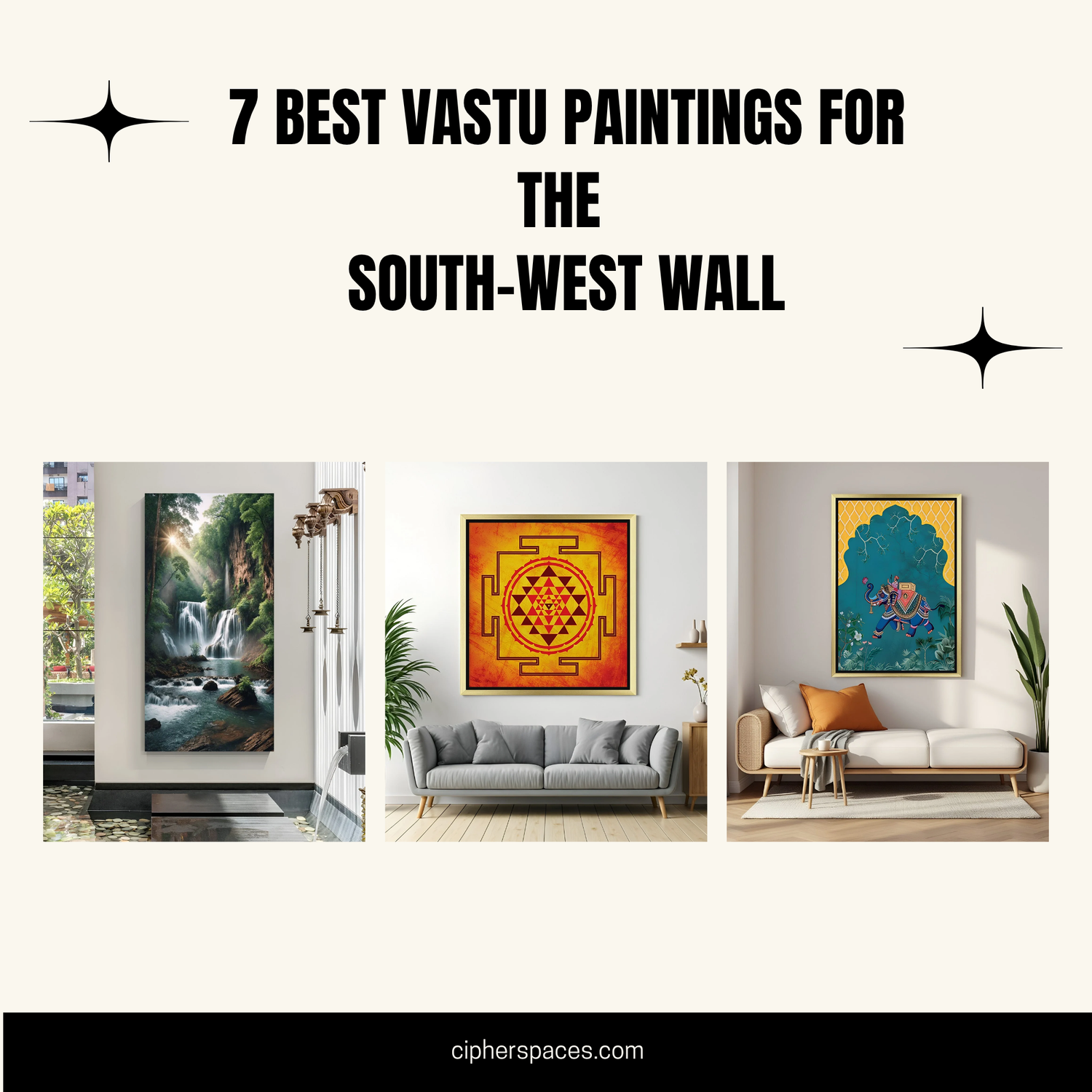
The south-west wall of your home is not just another surface to fill. According to Vastu Shastra, it is the energetic backbone of your entire household - the zone that governs financial security, long-term relationships, and personal authority. Choosing the right painting for the south-west wall as per Vastu reinforces all three. Get it wrong, and you quietly undermine the very foundation you're trying to build.
Most articles on this topic mix up the west wall and the south-west wall, lumping them together as if they carry identical energies. They do not. The south-west (Nairutya Kona) operates by its own elemental rules and needs a distinct approach. Below are the 7 best vastu paintings for the south-west wall, the reasoning behind each one, a room-by-room application guide, and a clear list of what to avoid.
Short Answer: Best Painting for South-West Wall as Per Vastu
The best vastu paintings for the south-west wall include mountain landscapes, elephant artwork, family portraits, earthy forest scenes, and paired birds or animals. This wall governs the Earth element (Nairutya Kona) - ruling stability, relationships, and wealth retention. Use earthy tones like ochre, brown, and taupe. Avoid water scenes, fire imagery, and abstract chaotic artwork on this wall.
Why the South-West Wall Is Unlike Every Other Direction
Before choosing any painting, it helps to understand what makes this direction unique within Vastu Shastra.
The south-west corner - known as Nairutya Kona - is governed by the Earth element and ruled by the planet Rahu. It is the direction of stability, ancestral strength, and the retention of wealth. When this zone is well-balanced and energetically "heavy," it anchors your household's finances, trust, and family unity. When it is weakened or disrupted - by the wrong art, colours, or structural choices - it introduces financial instability, strained relationships, and a general sense of insecurity.
The south-west also governs authority and decision-making. It is the direction most directly associated with the head of the household and their ability to lead, protect, and provide.
The guiding principle for art on this wall is straightforward: anything grounded, heavy, and permanent belongs here. Anything fluid, fiery, or chaotic does not.
The 7 Best Vastu Paintings for the South-West Wall
1. Mountain Landscapes - The Gold Standard
Mountain paintings are the single most recommended artwork category for the south-west wall across all Vastu traditions - and the logic is elemental, not arbitrary. Mountains are the physical embodiment of the Earth element: immovable, enduring, and protective. A mountain painting here acts as a visual anchor, reinforcing the message that your household stands on solid, unshakeable ground.
Mountain paintings on the south-west wall are also linked to strength in both personal and professional life, making them equally effective in a home office as in a living room.
What to look for: Rugged, majestic peaks rather than soft rolling hills. Browns, greys, deep greens, and ochre tones. Avoid mountains with stormy skies, flooding, or avalanche scenes - the painting should convey permanence, not disaster.
2. Elephant Paintings - Wisdom, Strength, and Prosperity
Elephants are particularly powerful for this direction because they embody both the Earth element (heavy, grounded, immovable) and the qualities governed by the south-west zone: authority, protection, and family strength. Elephants with raised trunks are believed to attract good fortune and dispel conditions that obstruct prosperity. A pair of elephants is especially auspicious if strengthening relationships is your priority.
What to look for: Elephants facing inward toward the room, with raised trunks or in a calm, composed posture. Earthy tones - terracotta, gold, deep brown. Avoid elephants in distressed or aggressive postures.
3. Family Portraits and Group Celebrations
The south-west wall is Vastu's designated zone for family energy, making it the ideal location for family portraits. Joyful and harmonious images placed here are believed to strengthen emotional ties and bring long-term peace within the household.
What to look for: Images where people appear happy, close, and engaged with each other. Warm, well-lit photographs. Ensure the frame is sturdy and the image is in excellent condition - worn or damaged photos are a Vastu defect regardless of their content.
Avoid: Solo portraits (they reinforce isolation), images of conflict or estrangement, and photos where people appear cropped out or disconnected.
4. Earthy Forest and Nature Landscapes
Artworks featuring mature trees, forests, fields, or grounded natural landscapes reinforce the Earth element and promote mental clarity, emotional resilience, and wise decision-making. These are ideal where a personal photo isn't preferred but the same grounding energy is needed.
Colours that work: Deep greens, earthy browns, amber, muted gold, and warm ochre. Think lush meadows, ancient forests, or dappled forest light - not a windswept barren landscape or a stormy jungle scene.
5. Paired Birds or Animals - for Relationship Harmony
If your priority is strengthening a marriage, partnership, or family bond, paired imagery is your most targeted tool. Paintings of two swans, peacocks, cranes, or other birds in calm, harmonious postures directly reinforce the relational energy this wall governs. The key word is pair - a single figure here can subtly reinforce isolation rather than togetherness.
For more on the Vastu benefits of peacock art specifically, read our guide on peacock wall art: Vastu benefits and placement.
6. Strong Trees and Pine Landscapes
A grove of tall, upright pine trees or a solitary ancient tree reinforces the south-west wall's energy of longevity, inner strength, and stability. Pine trees in Vastu are associated with long life, positive relationships, and open communication within the home.
7. Vastu Yantra or Spiritual Earth Imagery
For households dealing with a known Vastu defect in the south-west zone - a toilet, kitchen, or missing corner - a framed Nairutya Yantra or mountain painting without any water element is recommended by Vastu practitioners as an energetic correction tool. This works best alongside other structural remedies but can meaningfully stabilise the zone's energy on its own.
Prefer Deity or Relationship-Themed Art? Radha Krishna and Shiv Parvati Paintings
Because the south-west corner governs relationships and commitment as much as it governs Earth-element stability, many households choose devotional relationship art here instead of - or alongside - landscape pieces. Radha Krishna paintings are a popular south-west wall choice for exactly this reason: the pairing symbolises devoted partnership, which aligns with the zone's relational energy. Shiv Parvati and Ardhanarishvara artwork works similarly, representing the union and balance of masculine and feminine energy, while Hanuman Ji paintings add a protective, grounding presence to the same corner.
This is a genuinely different visual style from the mountain/elephant/forest route above - richer colour, devotional subject matter - so it suits a more traditional or spiritually-styled home rather than a minimal one. If that's the direction you want to go, browse our South-West Wall canvas painting collection, curated specifically around Radha Krishna, Shiv Parvati, and Hanuman Ji pieces for this direction. For more on the symbolism, see is Radha Krishna wall art good for your home?
Quick-Reference Table: South-West Wall Paintings at a Glance
| Painting Type | Primary Vastu Benefit | Best Colours | Room Suitability |
|---|---|---|---|
| Mountain landscape | Financial stability, grounding | Ochre, brown, grey-green | Living room, bedroom, office |
| Elephant painting | Authority, protection, prosperity | Terracotta, gold, brown | Living room, entrance area |
| Family portrait | Relationship harmony, togetherness | Warm, well-lit tones | Bedroom, living room |
| Forest / nature scene | Emotional resilience, clarity | Deep green, amber, earthy brown | Any SW wall in any room |
| Paired birds or animals | Marital and partnership harmony | Beige, pastel, warm taupe | Bedroom |
| Pine / strong trees | Longevity, communication, bonds | Deep green, brown | Study, living room |
| Radha Krishna / Shiv Parvati | Relationship devotion, union, balance | Gold, deep blue, traditional palette | Bedroom, pooja room, living room |
| Yantra / spiritual earth art | Vastu correction, positive energy | Gold, copper, earthy tones | Any room with SW defect |
What to Absolutely Avoid on the South-West Wall
- Water imagery: Waterfalls, rivers, ocean scenes, aquariums, or fish paintings all introduce the Water element into an Earth zone, creating an elemental clash. Water belongs on the north or north-east walls, not here. See our guide on the best direction for waterfall paintings as per Vastu.
- Fire imagery: Candles, bonfires, dramatic red-sky sunrises, or abstract work dominated by bold reds and oranges introduce Fire energy into an Earth zone.
- Abstract or chaotic art: Highly dynamic abstract work with jagged lines, dark palettes, or a sense of speed or conflict undermines this wall's stabilising purpose.
- Solitary or melancholic figures: A lone figure, a grieving scene, or any image evoking isolation contradicts the relational, communal energy the south-west governs.
- Mirrors and glass panels: Mirrors expand space energetically - the opposite of what this direction requires. If unavoidable, keep them covered.
- Cool or dark colour palettes: Blues, blacks, and stark cool tones are suited to the north and west zones. On the south-west wall, they disrupt the Earth element's grounding energy.
- Damaged or worn artwork: A painting with fading, tears, or a cracked frame carries stagnant energy regardless of subject matter.
Room-by-Room Application Guide
South-West Wall in the Living Room
This is your highest-priority placement. It's visible daily to the entire household and has the broadest energetic influence on the home's collective atmosphere. A large mountain landscape or a prominent elephant painting works powerfully here - size matters: aim for at least 50–60% of the wall's width. See our living room wall art Vastu scenery and styling guide for more.
South-West Wall in the Master Bedroom
The master bedroom in the south-west zone is considered one of the most auspicious placements in Vastu - it enhances the authority, stability, and prosperity of the household's head. For the SW bedroom wall, paired imagery (birds, animals, or a family portrait) is most effective, or a Radha Krishna piece if you prefer devotional art. Avoid visually "loud" imagery that could disrupt sleep. Read our guide to best Vastu wall art for bedroom peace and positivity.
South-West Wall in the Home Office or Study
A mountain painting is the first choice here - it reinforces the mental fortitude and long-term vision required for sustained professional success. Strong tree or pine forest paintings work equally well. Browse our office wall art collection for Vastu-aligned options.
The Elemental Logic: Why This Works
Vastu Shastra is fundamentally a system of elemental harmony. Each direction channels one of five elements - Earth, Water, Fire, Air, or Space. The south-west is Earth. Every painting carries an elemental energy through its subject, composition, and colours. Mountains are Earth. Water scenes are Water. Fire imagery is Fire.
When you place a Water painting on an Earth wall, you create an elemental clash - the equivalent of introducing instability into the zone designed to anchor your home. When you reinforce Earth with Earth-aligned imagery, you amplify the zone's natural strengths: stability, security, and the retention of what matters most.
For a broader introduction to how Vastu guides art placement throughout the home, read our guide to best Vastu paintings for home positivity and prosperity, and our overview of Vastu wall art rules and tips for positive energy.
Practical Checklist Before You Hang Anything
- Does the subject feel grounded, permanent, or stable? (Mountains, trees, earth - yes. Water, flames, fast movement - no.)
- Are the dominant colours earthy? (Browns, ochres, deep greens, warm golds - yes. Cool blues, stark blacks, bright reds - no.)
- Is the mood calm and uplifting rather than conflicted or desolate?
- Is the painting in excellent physical condition - no tears, fading, or damage?
- Is the frame sturdy and the hanging secure?
- Is the painting appropriately sized - aim for 50–70% of wall width?
- Is the artwork free of water, fire, or solitary imagery?
Frequently Asked Questions
Q1: What is the single best painting for the south-west wall as per Vastu?
A mountain landscape is universally considered the most effective painting for the south-west wall. Mountains directly embody the Earth element - the ruling element of this direction - and reinforce stability, strength, and permanence. Choose paintings with rugged, majestic peaks in earthy tones (ochre, brown, grey-green) for maximum effect.
Q2: Can I hang a Ganesha painting on the south-west wall?
Yes, with care. Ganesha as the remover of obstacles and symbol of wisdom and stability is broadly auspicious throughout the home. On the south-west wall specifically, a Ganesha painting in warm, earthy tones works well - particularly one depicting Ganesha in a calm, seated posture. Avoid placing it directly above a doorway or opposite a toilet wall.
Q3: Are water paintings strictly forbidden on the south-west wall?
According to Vastu principles, yes. Water is the element of the north and north-east zones. Introducing water imagery on the south-west wall creates an elemental conflict between Water and Earth. See our guide on where waterfall paintings should be placed for the correct direction.
Q4: What colours should south-west wall paintings feature?
Earth tones are the rule: brown, beige, ochre, warm gold, deep green, terracotta, and muted taupe. Avoid cool blues, stark blacks, and dominant reds. A small accent of warm gold within an otherwise earthy composition is fine - it's the dominant palette that matters most.
Q5: Can abstract art be placed on the south-west wall?
Yes, if it uses earthy tones and conveys groundedness rather than chaos or speed. A textured abstract in ochre, brown, and warm beige - suggesting earth, rock, or terrain - aligns with the zone's energy. Bold, jagged, or highly dynamic abstract work in cool or dark tones should be avoided here.
Q6: Does painting size matter for the south-west wall?
Yes - size is energetically significant, not just aesthetic. Aim for artwork covering 50–70% of the wall's width. For large walls over 10–12 feet, a single statement piece is more effective than multiple smaller frames, which can fragment the zone's stabilising energy.
Q7: My south-west wall is in the kitchen. What art should I use?
A kitchen in the south-west creates a Fire vs. Earth conflict in Vastu, which can promote instability and frequent disagreements. If structural relocation isn't possible, use earthy-toned art on the SW kitchen wall, avoid fire-themed imagery entirely, and paint surrounding walls in light yellow or beige. A mountain painting or earthy landscape is still the best choice here even in a compromised zone.
Q8: Does the frame material affect Vastu for the south-west wall?
Yes. Wooden frames in warm tones - walnut, teak, oak - align naturally with the Earth element and are ideal for this wall. Heavy stone or ceramic frames work well too. Avoid thin metallic frames in silver or chrome, as metal is elementally associated with the west and north-west zones.
The south-west wall is your home's energetic foundation. Treat it with intention - and the right painting here will do quiet, lasting work for your household's stability, relationships, and prosperity for years to come.
Explore our full South-West Wall canvas painting collection, or browse related directional guides: best paintings for the north wall, north-west wall Vastu paintings, and Vastu wall art to attract wealth and prosperity.